Stop Abandoning Your Planner! The Ultimate 2026 Guide to Daily, Weekly & Monthly Layouts
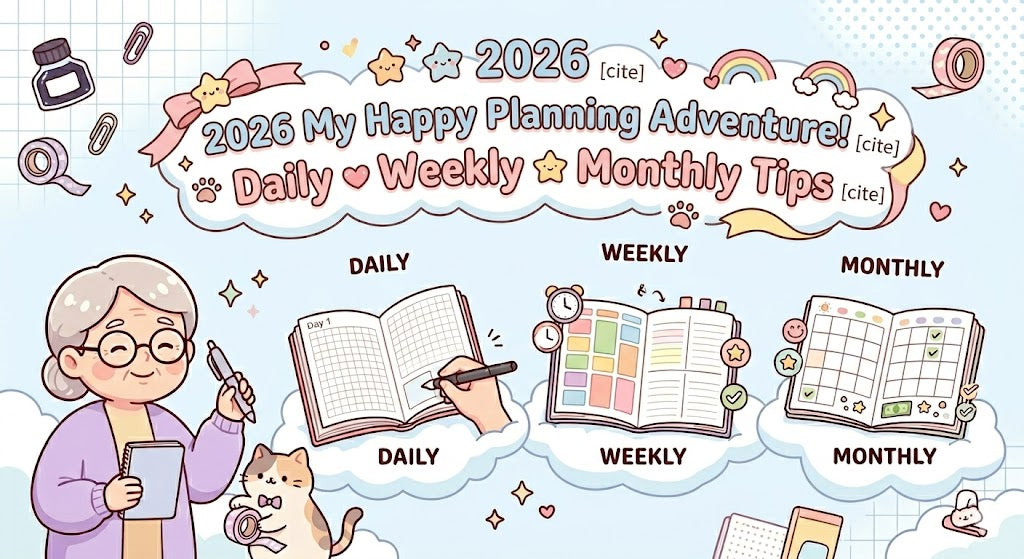
In 2026, the stationery world is shifting away from "hustle culture." The trend color is Pistachio Green (symbolizing balance). The focus isn't on filling every hour, but on "Mindful Planning." When choosing your book, look for layouts that allow for rest, not just work. Also, don't forget that 2026 has a long "Silver Week" in September—you'll need space to plan that vacation!
It happens every single year. The "Planner Cycle of Doom."
It starts in October. You walk into a stationery store (or browse our website), and you are seduced. You see the beautiful leather covers of the 2026 Hobonichi Techo. You feel the buttery smooth paper of the Midori MD. You buy the most expensive one, promising yourself: "2026 is the year I finally get my life together."
You start January 1st with perfect calligraphy. You track your water intake. You write a diary entry.
By January 15th, you miss a day. By February, the planner is gathering dust on your shelf, mocking you.

Listen to Auntie Mei: You are not lazy. You just chose the wrong tool.
Choosing a planner is not about the cover art. It is about "Time Granularity" (时间颗粒度). It is about matching the layout of the page to the wiring of your brain. Are you a "Zoomed In" person or a "Zoomed Out" person? Do you think in tasks or in stories?
In this massive guide, we will break down the three titans of the Japanese planner world: Daily, Weekly, and Monthly. I will tell you who they are for, who should AVOID them, and exactly how to use them so you never waste money on a planner again.
📋 Quick Diagnostic: What is your "Planner Personality"?
Don't overthink it. Which scenario sounds like your actual life?
"I have a lot of feelings. I want to stick movie tickets, draw doodles, track what I ate for lunch, and write about my day. My planner is basically a diary and a scrapbook combined."
👉 You need a Daily Planner.
"I have 5 meetings a day, 3 assignments due, and I need to know exactly when I have a free hour to eat. I don't care about feelings; I care about getting things done."
👉 You need a Weekly Vertical Planner.
"I hate writing. I just need to know when my exams are, when my rent is due, and whose birthday it is. I want something light that fits in my small bag. I mostly use my phone."
👉 You need a Monthly Planner.
"I am new to this and I am scared of commitment. I don't want to waste money on a big book I might not use."
👉 Auntie Mei's Pick: Jibun Techo Lite or an Undated Stalogy. A balance of everything without the bulk.
1. Daily Planners 2026: The Creative's Canvas

The "One Page Per Day" format (1Day 1Page) is the heavyweight champion of the stationery world. It offers maximum freedom. You have an entire A6 or A5 page dedicated to a single day, regardless of whether you have plans or not.
The Titan of this Category: Hobonichi Techo
When we talk about daily planners, we are mostly talking about the Hobonichi Techo. Why? Because of the paper. It uses Tomoe River S Paper—a magical, ultra-thin paper that allows a 400-page book to be incredibly slim. It handles fountain pens and watercolors beautifully without bleeding.
- Zero Restrictions: You can draw, write, paint, or paste.
- The "Life Log": By the end of the year, you have a thick autobiography of your life.
- Focus: You only see "Today," which helps reduce anxiety about tomorrow.
- "White Space Fear": If you have a boring day, that blank page can feel intimidating.
- Weight: These books are heavy. You probably won't carry an A5 Cousin everywhere.
- Price: They are an investment ($40-$60+).
🛑 Who Should AVOID This?
If you are a perfectionist who will quit the moment you miss a single day, do not buy a Daily Planner. You will feel guilty by February.

The Strategy: How do you organize a massive A5 page without it looking messy? Divide and conquer.
- Draw the T: Take a ruler (or just freehand it) and draw a vertical line down the middle of the page, and a horizontal line across the bottom (creating an upside-down 'T' shape).
- Top Left (The Hard Landscape): Write your schedule here. Meetings, classes, appointments. This is the "Must Do" column.
- Top Right (The Soft Landscape): Write your To-Do list, groceries, or reminders. This is the "Can Do" column.
- Bottom (The Soul Section): This is the secret to loving your planner. Use this bottom space to write one good thing that happened, paste a receipt, or stick a massive PET tape sticker.
Pro Tip: On days where you do nothing, simply take a large landscape PET sticker and paste it across the page. Boom. Decorated. No writing needed.
2. Weekly Planners 2026: The Productivity Machine

The Weekly planner allows you to see your entire week (Monday to Sunday) at a single glance. It is the perfect balance between "big picture" and "details." It is the favorite choice of students and office workers.
The Two Main Layouts You Must Know
- Vertical (The Time Blocker): Time slots (e.g., 6 AM to 12 PM) run down the page in columns. This is essential if your day is broken into appointments.
- Left-and-Memo (The "Weeks" Style): The days are listed horizontally on the left page, and the right page is just blank grid paper. This is the most popular layout for "To-Do List" people who don't have many fixed meetings.
- Time Management: You can visually see how much free time you actually have.
- Portability: Weekly planners (like the Hobonichi Weeks) are usually wallet-sized.
- Less Pressure: Smaller writing spaces mean less pressure to write a novel.
- Space Constraints: Not enough room for journaling or large stickers.
- Rigidity: If you have a super busy Tuesday but an empty Wednesday, you can't "borrow" space from Wednesday.
The Strategy: A weekly planner full of black ink looks stressful. We use color to understand our life balance.
- Step 1: Get 3 colors of Mildliner Highlighters (e.g., Pink, Blue, Grey). Do not use neon colors; they hurt the eyes.
-
Step 2: Assign meaning:
🌸 Pink = Deep Work / Urgent
🦋 Blue = Self Care / Fun / Gym
🌫️ Grey = "Dead Time" (Commuting, Chores) - Step 3: Draw vertical lines or boxes in the time slots before writing the text.
- Result: At the end of the week, look at the page. Is it all Pink? You are burning out. Is it all Blue? You might need to study more.
3. Monthly Planners 2026: The "No Stress" Zone

These are thin, lightweight notebooks that only contain the "Month on Two Pages" spread. They are stress-free. If you skip a week, nobody knows. If you go on vacation, you don't waste 7 pages.
Who is it for?
- Digital Hybrids: You use Google Calendar for alerts, but need a paper backup to visualize deadlines.
- Project Trackers: People who only need to track one specific thing (e.g., "Gym Days," "Content Posting Schedule," or "Finance").
- Students: Specifically for tracking exam dates and assignment deadlines.
If you choose a thin Monthly Planner, you have extra room in your bag for tools. Here is the perfect "Everyday Carry" setup to increase your average order value:
For drawing clean lines.
Attaches your pen to the cover.
4 colors in 1 body (saves space).
The Problem: Monthly blocks are tiny. You cannot write "Dinner with Sarah at 7 PM at the Italian place" in a 3cm box.
The Solution: Bullet Journaling logic.
- Step 1: Use Icon Stickers (tiny 5mm stickers) or draw symbols.
-
Step 2: Define your key:
🔴 Dot Sticker = Hard Deadline (Essay due)
⭐ Star = Social Event
💰 Money Sign = Payday - Step 3: Only write the time and the name. "7pm Sarah." The rest goes in your phone.
4. The Ultimate Showdown: Specs Comparison
Still undecided? Let’s look at the hard data. This table compares the 2026 heavyweights.
| Feature | Daily (1 Day 1 Page) | Weekly (Vertical/Weeks) | Monthly (Basic) |
|---|---|---|---|
| Best Brand | Hobonichi Cousin / Midori MD | Jibun Techo / Hobonichi Weeks | Kokuyo Campus / Rollbahn |
| Writing Space | ⭐⭐⭐⭐⭐ (Max) | ⭐⭐⭐ (Balanced) | ⭐ (Minimal) |
| Weight | Heavy (Home use) | Medium / Slim | Featherlight (EDC) |
| Pressure Level | High (Must write daily) | Medium | Low (Stress-free) |
| Best Accessory | Large PET Stickers | Highlighters | Mini Icon Stickers |
🧪 Bonus: The Pen-to-Paper Matrix
Paper matters. Japanese paper is different. Here is how your favorite pens will react.
| Pen Type | Tomoe River S (Hobonichi) | MD Paper (Midori) |
|---|---|---|
| Gel Pens (Zebra Sarasa) | Smooth, takes 5s to dry. Good Match |
Fast drying, slight feedback. Perfect Match |
| Fountain Pens (Pilot) | Shows amazing sheen/shading. Best in Class |
No bleeding, pleasant scratchiness. Excellent |
| Brush Pens (Kuretake) | Can handle light layers. Good |
Slight ghosting if heavy. Okay |
5. The Pro Strategy: The "Digital-Analog" Workflow

In 2026, we don't need to choose between a phone and a book. We use both. The trend is "Hybrid Planning."
Why do you need paper if you have a phone? Because phones are "Reactionary" (Notifications, Alarms), while paper is "Intentional" (Thinking, Dreaming).
Auntie Mei's Hybrid Workflow:
- Google Calendar: Holds the "Hard Landscape." Dentist appointments, flight times, Zoom links. (Things that beep at you).
- Paper Planner: Holds the "Soft Landscape." Your daily focus, your feelings, your memory keeping. (Things that require silence).
- The Sync: Every Sunday night, open your phone and copy the big events into your paper planner. This act of writing helps you mentally prepare for the week.
❤️ The "Anti-Guilt" Movement
Before you buy, I need you to promise me something.
In 2026, we are embracing Creative Chaos. If you miss a week, don't quit. Don't go back and try to fill it in from memory. Just turn the page and start today. A messy planner is a loved planner. A perfect planner is usually empty.
Conclusion
There is no "perfect" planner, but there is a perfect planner for you.
If you are a visual thinker who needs to dump your brain on paper, go Daily. If you are a structured worker who needs to optimize efficiency, go Weekly. If you crave freedom and hate obligation, go Monthly.
Don't be afraid to experiment. And remember, if you leave a page blank... that's just a perfect excuse to buy more stickers to cover it up!
Frequently Asked Questions
Japanese stationery brands (like Hobonichi and Midori) typically release their 2026 collections in September or October 2025. Popular covers and limited editions sell out within days, so pre-ordering is highly recommended. If you wait until January 2026, the best designs will likely be gone.
A Vertical layout has time slots (e.g., 6 AM - 10 PM) running down the page, which is perfect for scheduling meetings and time-blocking. A Horizontal layout has boxes for each day, which is better for writing to-do lists, short diary entries, or journaling. Choose vertical for managing time, horizontal for managing tasks.
Look for planners using Tomoe River S paper (found in Hobonichi Techo) or MD Paper (found in Midori planners). These papers are specifically engineered to prevent ink bleeding, feathering, and ghosting. Avoid standard generic planners if you use wet inks.
It can be if you force yourself to write full pages of text. However, many users utilize the extra space for creative outlets like sticking movie tickets, photos, large PET stickers, or drawing. If you miss a day, simply use that blank page for general notes later. Don't let the page bully you!
Yes! You should look for "Undated Planners" (like the Stalogy 365 or Midori MD Undated). These allow you to fill in the dates yourself, so no pages are wasted if you start in April or July. This is great for people who fall off the wagon and want to restart.
Most Western planners start in January. However, in Japan, the fiscal and school year begins in April, so many Japanese brands (like Hobonichi) offer specific "April Start" versions (often called Spring Editions) for students and teachers. Be careful when buying to check the start date!
The key is "habit stacking." Keep your planner open on your desk next to your computer so it is always visible. Also, lower your expectations—don't try to make every page "Instagram perfect." A messy planner is a used planner. Choosing a Weekly layout is often safer for beginners than a Daily one because it requires less writing.