What Your Handwriting Says About You: The Psychology of Penmanship & Finding Your Stationery Soulmate
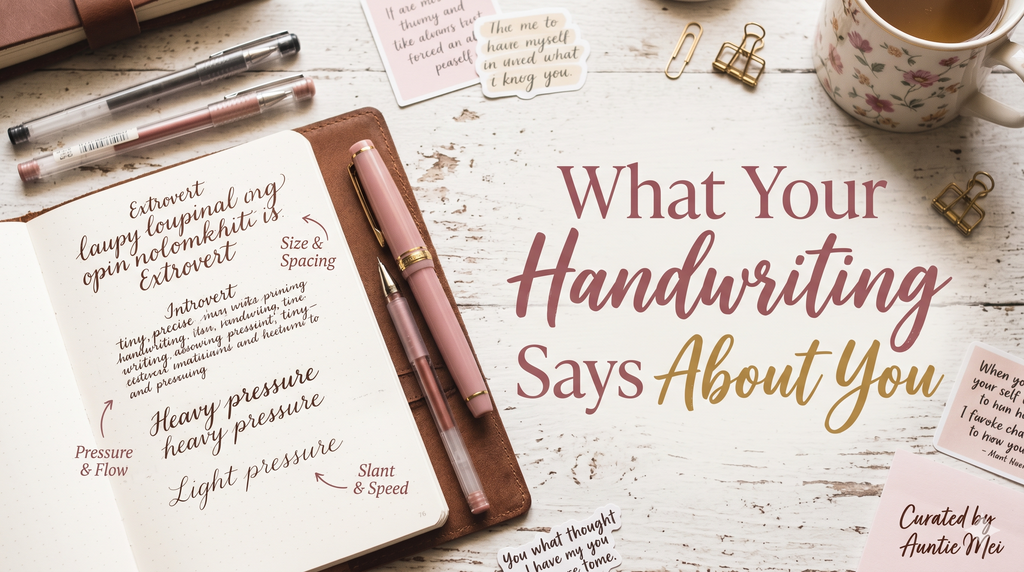
We live in an era dominated by glass screens, ergonomic keyboards, and autocorrect. The act of writing has been largely outsourced to silicon chips. Yet, despite the convenience of digital communication, we still hold a deep, almost irrational reverence for a handwritten letter, a physical journal entry, or a hastily scribbled sticky note on the fridge.
Why? Because typing is a standardized, mechanical process. When you press the letter "A" on your keyboard, it looks exactly identical to the letter "A" pressed by millions of other people around the globe. It is devoid of emotion, tension, and personality.
Handwriting, however, is a biological miracle. It is an incredibly complex neurological ballet involving your brain's motor cortex, your central nervous system, and the dozens of tiny muscles in your hand and wrist. When you write, your hand is merely holding the pen; it is your subconscious mind that is actually driving the ink across the page. This is the foundation of Graphology (the study of handwriting psychology).

"Your handwriting is an electrocardiogram of your subconscious. The loops, the pressure, and the speed are not random—they are the physical manifestations of your personality, your anxieties, and your hidden desires."
When I sit down to practice my calligraphy or test out a new batch of Japanese gel pens for our shop, I can instantly see my current mental state reflected in the strokes. On days when I am stressed, my letters become cramped and jagged. On days when I am relaxed, they flow with generous, sweeping curves.
Have you ever looked at your own messy notes and wondered: "What does my handwriting say about me?" Have you ever felt frustrated that your hand cramps up, or that your ink always smudges, leading you to believe you just have "bad handwriting"?
Today, Auntie Mei is going to help you decode your brain's fingerprint. We will analyze your penmanship across four distinct psychological dimensions: Size, Pressure, Slant, and Speed. By the end of this guide, you will not only understand your personality on a deeper level, but you will finally understand exactly why certain pens feel terrible in your hand, and how to find your true "Stationery Soulmate."
Part 1: Size & Spacing - The Extrovert vs. The Introvert
The very first thing a graphologist looks at is the sheer scale of your handwriting. The size of your letters represents how much space you feel you deserve to take up in the world. It is a direct reflection of your social battery and your level of extroversion.

Large Letters: The Spotlight Seeker
If your handwriting consistently touches the top and bottom of the lines in a standard notebook (or even spills over them), you have "Large" handwriting. Psychologically, this indicates an extroverted, outgoing, and highly confident personality. You are not afraid to be noticed. You likely have a bold presence, enjoy being the center of attention, and think in big-picture concepts rather than tiny details.
However, large handwriting also indicates a desperate need for freedom. You hate feeling constrained by strict rules or microscopic guidelines.
Your Common Pain Point: People with large handwriting often feel claustrophobic using standard, narrow-ruled college notebooks. Your letters feel suffocated, and you constantly run out of space on the page, making your notes look chaotic.
If you have a big personality, you need a pen that can keep up with your sweeping gestures. Stop trying to use scratchy, needle-point pens. You need a tool that delivers a thick, confident line.
Auntie Mei recommends stepping up to a 0.7mm or even 1.0mm Broad Tip Gel Pen. The wider rollerball glides effortlessly over the paper, allowing your large loops to form smoothly without skipping. Pair this with a Blank Sketchbook or a wide-ruled B5 Planner. Removing the horizontal lines entirely gives your extroverted mind the unconstrained runway it needs to brainstorm without borders.
Small Letters: The Analytical Introvert
If your letters barely take up half the vertical space of a ruled line, and you write in tiny, tightly controlled script, you fall into the "Small" category. This is the hallmark of an introverted, deeply analytical, and highly focused mind. You possess an incredible ability to concentrate on granular details that others overlook. You are likely methodical, observant, and prefer a small, intimate circle of friends over a massive, loud party.
Your Common Pain Point: If you use a cheap, thick ballpoint pen, your tiny "e"s and "a"s will immediately fill in with ink, turning your precise thoughts into illegible, blurry blobs. You require surgical precision.
The introverted, detail-oriented writer is exactly who the Japanese stationery market was built for. You need absolute control over your ink flow to match the tight control you have over your thoughts.
Your stationery soulmate is a 0.38mm (or even a hyper-fine 0.28mm) Japanese Gel Pen, such as the Uni-ball Signo or the Pilot Juice Up. These needle-point tips dispense a razor-thin line of archival ink, ensuring that even your most microscopic notes remain perfectly legible. Pair this with a 5mm Dot Grid Journal. The subtle dots provide the exact structural matrix your analytical mind craves, without visually overpowering your delicate handwriting.
Part 2: The Pressure - The Depth of Your Emotions
Flip your notebook page over and run your fingers gently across the back of the paper. Can you feel the physical indentations of your words embossed into the sheet? The amount of physical force you apply to the paper is one of the most revealing aspects of graphology. It measures your emotional intensity and vitality.

Heavy Pressure: The Passionate Force
If you leave deep grooves in the paper, you are a "Heavy Pressure" writer. You experience emotions—both positive and negative—with profound intensity. You are highly committed to your beliefs, deeply passionate, and when you promise to do something, you follow through with unshakeable resolve. However, heavy pressure also indicates high levels of internal tension, stress, or a subconscious desire to leave a permanent, undeniable mark on the world.
Your Common Pain Point: Hand cramps. Because you grip the pen like it owes you money and drive the nib into the desk, your wrist tires out incredibly fast. Furthermore, your heavy hand causes standard pens to bleed straight through thin notebook paper, ruining the reverse side of the page.
You cannot force yourself to write lighter; it is wired into your nervous system. Instead, you must change the hardware. You absolutely must upgrade to an Ergonomic Pen with an Alpha Gel or thick silicone grip. This squishy barrier absorbs the intense shock and pressure, saving your tendons from fatigue.
Light Pressure: The Adaptable Empath
If your writing barely skims the surface of the paper, leaving no physical trace on the back of the sheet, you are a "Light Pressure" writer. You are highly adaptable, empathetic, and generally easygoing. You do not let emotional baggage weigh you down, preferring to glide through life's challenges without unnecessary friction. You avoid confrontation and are excellent at going with the flow.
Your Common Pain Point: Cheap ballpoint pens require significant physical downward pressure to make the internal ball bearing roll and dispense the sticky ink paste. Because you write lightly, these pens constantly skip, fade, and fail to write for you, forcing you to go back and rewrite letters.
If you have a light, airy touch, you must use a writing instrument that utilizes capillary action rather than mechanical friction. Your ultimate match is a Fountain Pen.
A properly tuned fountain pen requires literally zero pressure to write. The moment the metal nib kisses the paper, the water-based ink flows beautifully onto the page via microscopic capillary channels. It transforms the act of writing from a chore into a frictionless, elegant glide that perfectly matches your easygoing personality.
Part 3: The Slant - Where is Your Mind Pointing?
Draw a straight, vertical line down your page. Now look at the vertical stems of your letters (like the straight lines in "t", "l", or "h"). Do they lean away from that line? The slant of your handwriting reveals the tug-of-war between your heart and your head.

Write the sentence: "The quick brown fox jumps over the lazy dog" in your normal, everyday handwriting.
Now, look closely at the letters. Which way are they falling?
The Right Slant: Heart Over Head
If your letters lean heavily to the right (forward), you are emotionally expressive, highly affectionate, and future-oriented. You are guided by your heart. You act quickly on your feelings, love socializing, and eagerly look forward to what comes next. You wear your heart on your sleeve.
The Left Slant: Guarded and Introspective
If your letters lean backward to the left, you are fiercely independent, introspective, and highly guarded. You prefer to observe situations quietly before engaging. You process your emotions internally rather than expressing them openly. A left slant often indicates someone who is protecting themselves or holding onto the past.
The Vertical Slant: The Pragmatic Rock
If your letters stand perfectly straight up and down, you are ruled by absolute logic. You do not let your emotions dictate your decisions. You are pragmatic, level-headed, and incredibly reliable in a crisis. When everyone else is panicking, you are the one calmly finding the solution.
- For the Right Slant (Emotional): Ground your impulsive thoughts with calming, earthy tones. Switch from standard blue to a deep Olive Green or a Sepia Brown gel pen. These natural hues provide a subconscious anchoring effect.
- For the Vertical Slant (Logical): Since your brain is so strictly pragmatic, inject some creative joy into your notes. Break the monotony with vibrant Color Psychology Highlighters. Use a warm peach or a soft pink to highlight ideas that actually bring you joy, forcing your logical brain to acknowledge emotion.
Part 4: The Speed & Shape - The Thinker vs. The Doer

Connected & Fast: The Impatient Visionary
If you write rapidly, stringing your letters together into a fluid (and sometimes illegible) cursive-print hybrid, your brain is moving at a million miles an hour. (Spoiler alert: If people tell you that you have "terrible" handwriting, this is usually why. We will dive deep into the science of "messy genius handwriting" in our next article!)
You are a visionary. You see the end goal immediately, and you become impatient with the slow, physical process of writing it down. You connect your letters because lifting the pen off the paper wastes precious milliseconds of thought.
Your Common Pain Point: Because your hand is flying across the page, the heel of your palm constantly drags over the fresh ink, smudging your brilliant ideas into a blurry disaster (this is a universal nightmare for left-handed writers, too).
You need an ink that can keep up with your accelerated timeline. You must abandon slow-drying liquid rollers and switch exclusively to Quick-Dry Japanese Gel Pens (like the Zebra Sarasa Dry or the Pentel EnerGel). These pens utilize advanced ink formulations that flash-dry into the paper fibers in less than a second, completely eliminating smudges no matter how fast your hand moves.
Disconnected & Slow: The Methodical Perfectionist
If you write in neat, disconnected print, taking the time to carefully construct every single letter, you are a methodical perfectionist. You think linearly and logically. You prefer to evaluate facts carefully, plan your steps, and execute flawlessly. You value clarity and order above raw speed.
Your Common Pain Point: The fear of making a mistake. Because you value a pristine, perfectly structured page, crossing out a misspelled word with a harsh black line completely ruins the aesthetic of your journal and causes you deep, visceral frustration.
You need a safety net that allows you to strive for perfection without the anxiety of permanent errors. Your soulmate is the Pilot Frixion Erasable Pen series.
The Stationery Soulmate Matrix
Let's synthesize everything we've learned. Use this matrix to identify your psychological handwriting profile and discover the exact tools Auntie Mei curates to solve your specific writing pain points.
| Handwriting Trait | Psychological Meaning | Your Common Pain Point | Auntie Mei's Perfect Match |
|---|---|---|---|
| Tiny, Cramped Letters | Introverted, highly focused, detail-oriented, analytical. | Your tiny letters blur together and become illegible with cheap, thick pens. | 0.38mm Japanese Gel Pens & Micro-Dot Grid Notebooks. |
| Heavy Pressure | Intense emotions, deeply committed, highly reactive, tense. | Severe hand cramps and wet ink bleeding straight through the paper. | Ergonomic Silicone Grips & Premium 100gsm Archival Paper. |
| Fast & Connected | Fast thinker, visionary, impatient, future-focused. | You smudge your own ink because your hand drags across the page too fast. | Quick-Dry Sarasa Gel Pens & Smooth-flowing Fountain Pens. |
| Large & Bubbly | Extroverted, loves attention, optimistic, craves freedom. | You run out of space quickly and feel suffocated on standard narrow-lined paper. | Blank Canvas Sketchbooks & Bold 1.0mm Tip Markers. |
The Graphology & Psychology FAQ
You asked, and the science has answered. Here are the most highly searched questions about the deep connection between your brain, your personality, and your penmanship.
Your handwriting is a physical reflection of your subconscious mind. The size of your letters reveals your social outgoingness (introvert vs. extrovert), the slant indicates your emotional expressiveness (logical vs. emotional), and the physical pressure you apply to the paper shows the intensity of your feelings, commitments, and internal stress levels.
While the field of clinical graphology is sometimes debated, neurology absolutely confirms that handwriting is "brain writing." The incredibly fine motor skills required to form tiny letters are controlled directly by your central nervous system. This means your physical and emotional state (stress, exhaustion, excitement) directly alters the neurological impulses that dictate the shape of your ink on the paper.
If your handwriting looks vastly different from day to day, do not panic—it does not mean you have multiple personalities! It simply means you are a highly adaptable, empathetic person who is deeply sensitive to your current environment or mood. A stressed, rushed brain will produce very different, jagged letters than a relaxed, creative brain journaling on a Sunday morning.
Heavy pen pressure indicates strong emotional intensity, deep commitment to your goals, and frequently, underlying subconscious stress or physical tension. If you consistently dent your paper or suffer from wrist cramps, you must stop using hard plastic pens. Switch to an ergonomic pen with a squishy silicone grip and use premium 100gsm paper to prevent the ink from bleeding through.
Yes. People who naturally write in a connected, cursive-style flow are often fast thinkers who make rapid, logical connections between abstract ideas. People who write in disconnected, block print format tend to be more methodical perfectionists, preferring to evaluate facts individually and make careful, deliberate decisions before executing an action.
This is a fascinating mix of biology and social conditioning. Developmentally, the fine motor skills in the hands and wrists often develop earlier in young girls than in boys. Additionally, throughout history, society has often encouraged and heavily rewarded girls for neatness, aesthetic presentation, and compliance during their formative schooling years, leading to lifelong structured handwriting habits.
You can consciously rewrite your habits through "Graphotherapy." This practice suggests that intentionally changing how you form your letters can subtly influence your mindset by rewiring neural pathways. To start, slow down. Switch from a slippery, uncontrollable ballpoint to a high-quality Japanese gel pen that provides slight "feedback" (friction) on the paper, allowing your brain to regain deliberate control over every single stroke.
Stop Guessing. Find Your Match.
There is no such thing as "bad" handwriting. Whether you are a heavy-handed, fast-thinking visionary or a meticulous, small-writing perfectionist, your penmanship is a beautiful reflection of your unique soul. The only mistake you can make is forcing your brain to use the wrong tools.
Are you ready to stop fighting with cheap pens and find the stationery that was literally engineered for your personality?