The Ultimate Mechanical Pencil Lead Size Guide: 0.2mm to 5.6mm Compared
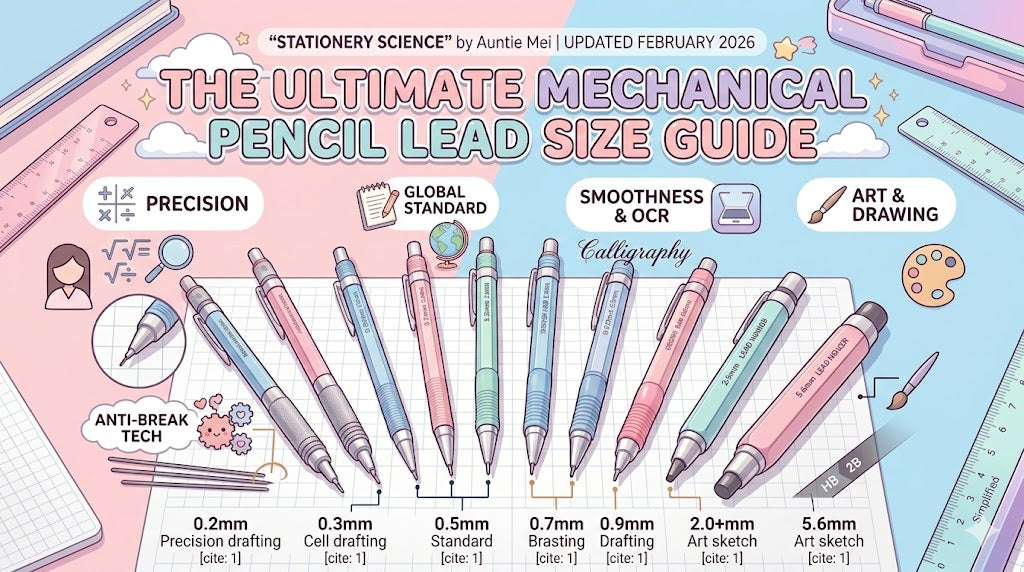
Written by Auntie Mei — Stationery reviewer with 10+ years of hands-on testing • Updated February 2026
Let's be honest: most of us buy a 0.5mm mechanical pencil by default. It is the global standard, the safe choice you grab off the shelf without thinking. But have you ever felt the visceral frustration of your lead snapping the moment you apply a little extra pressure? Or perhaps you've looked back at your lecture notes, only to find that your handwriting looks like a smudged, illegible spiderweb on the page?

The truth is, buying the wrong lead size for your specific writing task is exactly like wearing running shoes to a formal dinner. It technically gets the job done, but it feels completely out of place and ultimately limits your performance. The size of the graphite dictates your writing angle, the amount of pressure you can apply, the darkness of the line, and the level of hand fatigue you will experience after an hour of writing.
From the microscopic 0.2mm drafting tools used by premium Japanese planner enthusiasts to the massive 5.6mm lead holders wielded by fine artists, the stationery world offers a highly engineered spectrum of choices. In this comprehensive, 1500+ word guide, we will break down the physics, chemistry, and practical applications of every mechanical pencil lead size on the market. We will help you find the perfect match for your handwriting style, paper choice, and daily tasks.
1. The Micro-Precision: 0.2mm & 0.3mm

If you have incredibly tiny handwriting, if you love to squeeze massive amounts of information into small spaces, if you are a professional accountant dealing with complex ledgers, or if you are a STEM student writing advanced calculus, the micro-sizes are your ultimate tools.
Try writing a complex integral like ∫ab f(x) or a multi-layered fraction with a standard 0.5mm or 0.7mm pencil inside a 5mm grid—the subscripts and superscripts will bleed together into an illegible gray blob. A 0.3mm lead keeps every mathematical symbol surgically clean and distinctly separate.
These ultra-thin leads produce a line that is surgical in its precision. They are particularly beloved in the Japanese stationery community because they pair perfectly with the 3.7mm grid spacing found in premium notebooks like the Hobonichi Techo. They are also exceptional for reading enthusiasts who like to make tiny, neat annotations in the margins of their books without permanently damaging the pages with ink.
- The Core Advantage: The line never widens. Because the lead is so incredibly thin, it maintains a sharp point automatically. You never have to awkwardly rotate the pencil in your hand to find a sharp edge.
- The Major Drawback: Extreme fragility. If you apply the same writing pressure to a 0.3mm lead as you do to a standard wooden pencil, it will snap into a dozen pieces immediately. It requires a light, floating touch.
If you are left-handed, you naturally "push" the pencil across the page as you write from left to right, rather than "pulling" it like right-handed writers do. This pushing angle creates tremendous shear stress on the graphite tip. For lefties, 0.3mm is often a nightmare of constant breakage unless you have an incredibly light hand. If you are a southpaw, we highly recommend skipping directly to 0.5mm or utilizing an anti-break mechanism.
If you decide to venture into the 0.2mm or 0.3mm territory, you must pair the lead with an engineered "anti-break" pencil. Do not put this fragile lead in a cheap plastic tube.
You need to look for pencils with active suspension systems. The Zebra DelGuard utilizes a brilliant dual-spring mechanism that absorbs both vertical and diagonal shock—if you press too hard, the lead literally retracts into the barrel to save itself. Alternatively, the Pentel Orenz features a sliding metal guide pipe; the metal sleeve glides smoothly over the paper alongside the lead, protecting it entirely so you never actually expose the raw graphite while writing.
2. The Global Standard: 0.5mm

The 0.5mm lead is the undisputed king of the stationery world. Go into any office supply store anywhere on the planet, and 90% of the mechanical pencils on display will be calibrated for 0.5mm.
Why did this specific size become the standard? It is the ultimate compromise. It strikes the perfect mathematical balance between keeping a relatively sharp, legible point for standard lined paper, while maintaining enough structural thickness to withstand the average person's writing pressure. It is the "jack of all trades, master of none."
- Best For: High school and college students, everyday rapid note-taking, general office paperwork, and writing on standard copy paper.
- The Advantage: Universal availability. You can find 0.5mm replacement lead at any grocery store, pharmacy, or convenience store in an emergency. Furthermore, the sheer variety of pencil body designs available in 0.5mm is staggering compared to any other size.
3. The Smooth Operators: 0.7mm & 0.9mm

Many people abandon 0.7mm and 0.9mm leads after elementary or middle school, under the mistaken impression that they are "too thick" or "messy" for adult use. This is a massive missed opportunity. These thicker leads offer a buttery-smooth, deeply satisfying writing experience that thinner leads simply cannot physically match due to their surface area.
If you suffer from hand cramps after writing for an hour, or if you are known as a "heavy-handed" writer who constantly digs grooves into the paper, upgrading to a 0.7mm or 0.9mm pencil will instantly solve your problem. The thicker surface area glides over paper imperfections rather than scratching into them.
Did you know that mechanical pencils can be used for artistic lettering? If you are practicing calligraphy, working on your letterforms, or simply trying to improve your cursive handwriting, a 0.9mm pencil is a revelation.
When you pair a 0.9mm pencil with extremely soft 2B or 4B lead, the graphite behaves almost like a firm brush pen or a flexible fountain pen nib. Because the lead is thick, it allows for beautiful line weight variation: you get a thin line on the upstroke and a rich, dark, wide line on the downstroke depending on your pressure. It provides phenomenal tactile feedback on textured paper, making handwriting practice highly addictive.
The 2026 Digital Synergy: OCR & Scanning
We live in a hybrid world. If you are the type of person who writes notes by hand but uses a scanner app (like Adobe Scan, Evernote, or iOS Notes) to digitize and sync them to Notion or Obsidian, you need extreme contrast. A 0.5mm HB line often scans as a faint, broken gray line that Optical Character Recognition (OCR) AI struggles to read. A 0.7mm pencil loaded with 2B lead lays down a thick, jet-black line that camera scanners pick up perfectly, ensuring your handwritten notes are 100% searchable in your digital database.
4. The Giants: 1.3mm to 5.6mm (Clutch Pencils)

Once you cross the 1.0mm threshold, we leave traditional mechanical pencils behind and enter the specialized territory of "Lead Holders" (also known as clutch pencils). Instead of a ratcheting mechanism that pushes the lead out a millimeter at a time, these feature a metal claw (clutch) at the tip. Pressing the back button opens the claw entirely, allowing the massive graphite stick to drop down; you must catch it at your desired length.
- 1.3mm / 1.4mm (The Scantron Hero): These are incredibly popular for two specific demographics. First, young children learning to write, because the thick lead is virtually unbreakable under erratic pressure. Second, students taking standardized tests. A 1.3mm pencil fills in a multiple-choice bubble in a single, satisfying swipe, saving precious seconds during exams.
- 2.0mm (The Drafting Classic): This is the traditional standard for architects, woodworkers, and draftsmen. The 2.0mm lead mimics the exact thickness of the graphite core inside a standard wooden pencil. You get the exact feel of a traditional pencil, but the body never gets shorter. Most 2.0mm holders (like the Staedtler 780) feature a secret, built-in rotary sharpener hidden in the push-button cap.
- 3.15mm to 5.6mm (The Fine Art Behemoths): These are not meant for writing words. These massive graphite sticks are utilized strictly by fine artists for bold charcoal shading, blocking out large-scale canvas sketches, and expressive drawing. Holding a 5.6mm Kaweco Sketch Up feels like holding a piece of heavy, premium machinery.
5. Anatomy of a Mechanical Pencil (Know Your Tools)

To truly understand which size works best for you, you need to understand the hardware housing the lead. When shopping for premium mechanical pencils online, you will frequently encounter these terms:
- Guide Pipe (Sleeve): The tiny metal tube at the very tip that the lead comes out of. Drafting pencils have a long (4mm) fixed guide pipe to provide a clear view of the lead when using a ruler. Pocket pencils feature a retractable guide pipe so the sharp metal doesn't stab your leg or damage your pencil case.
- Knurled Grip: A metal grip section that has been cross-hatched with a diamond pattern (common in the Rotring 600 or Uni Kuru Toga Roulette). It provides an incredibly secure, non-slip grip, essential for sweaty hands during long drafting sessions.
- Clutch / Chuck: The internal mechanism, usually made of brass in high-quality pencils and plastic in cheap ones. It is the jaw that bites down on the lead to hold it in place while you write. A high-quality brass chuck prevents the lead from slipping back inside the barrel when you press down hard.
- Lead Grade Indicator: A small rotating window near the top of professional pencils that lets you manually display whether you have loaded HB, 2B, or H lead inside, preventing confusion if you own multiple pencils of the same size.
6. The Missing Link: Lead Hardness Chemistry

Choosing your ideal size is only half the battle. Your writing experience will still be miserable if you pair it with the wrong Lead Grade (Hardness). The graphite scale ranges from H (Hard/Light) to B (Black/Soft), with HB sitting right in the middle.
The grade is determined by the ratio of graphite (which makes it dark and soft) to clay/polymers (which makes it light and rigid).
The thinner your lead, the harder it needs to be to prevent snapping. The thicker your lead, the softer it can be to maximize smoothness and dark pigment.
- 0.3mm + HB: Strong enough to withstand pressure without breaking, keeping the micro-point sharp.
- 0.5mm + B: The sweet spot for most users. It offers a much darker line than standard HB, with very little smudging.
- 0.7mm/0.9mm + 2B (or 4B): Incredibly smooth, dark, and lush. Perfect for OCR scanning, cursive handwriting, shading, and reducing hand strain.
7. Brand Quality: Does Replacement Lead Actually Matter?

One of the biggest mistakes you can make is buying a $20 premium mechanical pencil and filling it with a $1 tube of generic, discount-store replacement lead. Cheap leads use low-quality clay binders. They contain microscopic impurities that literally scratch your paper, and they produce a faint, grayish line that is highly prone to breaking.
Always invest in premium Japanese Resin-Infused (Polymer) leads. Modern stationery chemistry has completely revolutionized the graphite core:
- Uni NanoDia / Uni Smudge-Proof: Mitsubishi Pencil (Uni) infuses their graphite with millions of nano-diamond particles. This creates extreme structural strength and incredibly crisp, dark lines. Their newest "Smudge-Proof" formulation is an absolute lifesaver for left-handed writers, as it binds the graphite dust to the paper instantly, preventing that dreaded side-of-the-hand smear.
- Pentel Ain Stein: This legendary lead features a ceramic cell structure integrated into the graphite. It holds the graphite molecules together tightly, making it highly resistant to breakage while remaining buttery smooth across the page.
8. The Showdown Matrices (Compare & Decide)
Table 1: Size vs. Use-Case Matrix
| Lead Size | Best For | Ideal Paper Type | Breakage Risk |
|---|---|---|---|
| 0.2mm - 0.3mm | Micro-journaling, complex math, book annotations | Smooth, high-quality (e.g., Tomoe River, Midori) | High (Requires anti-break pen / Bad for Lefties) |
| 0.5mm | Everyday writing, standard notes, general office use | Standard notebook / Copy paper | Low - Moderate |
| 0.7mm - 0.9mm | Handwriting practice, Notion OCR scanning, fast sketching | Textured paper, sketchbooks, heavy bond | Very Low |
| 1.3mm - 5.6mm | Scantron exams, architectural drafting, fine art | Any paper type, wood, canvas | Zero (Virtually unbreakable) |
9. Frequently Asked Questions (FAQ)
Absolutely not. Mechanical pencils are precision-engineered instruments. The internal brass clutch is machined to grip exactly one size. If you put 0.5mm lead into a 0.7mm pencil, it will simply slide completely out of the metal tip. If you force a 0.7mm lead into a 0.5mm pencil, you will permanently jam and ruin the mechanism.
Usually, it is a combination of two factors: heavy writing pressure and extending the lead too far out of the pipe. For 0.3mm, you should only click the lead out by 1mm (barely visible). If it still breaks constantly, you must switch to a harder lead grade (like HB or H) or upgrade to an advanced pencil like the Pentel Orenz, which is specifically designed to protect micro-leads.
If you write fast and aggressively during lectures, 0.7mm is vastly superior. The thicker point glides across the paper faster with significantly less drag. More importantly, it won't snap mid-sentence when you are rushing to copy down what the professor is saying.
Most professional illustrators and comic artists use a combination approach. They rely on 0.5mm (or even 0.3mm) for fine, technical details like eyes, hair texture, and sharp edges. However, they switch to 0.9mm or a 2.0mm lead holder for shading, blocking out initial geometric shapes, and creating bold, dynamic outlines.
Yes, and it is a highly recommended technique! A 0.7mm or 0.9mm mechanical pencil loaded with soft 2B or 4B lead is excellent for practicing letterforms and cursive. The soft, thick graphite provides great shading, paper feedback, and line variation based on your hand pressure, mimicking the feel of expensive calligraphy tools.
The grade indicates the physical ratio of graphite to clay/polymers inside the lead core. 'H' stands for Hard (more clay, resulting in a lighter, grayer line that resists smudging). 'B' stands for Black (more graphite, resulting in a darker, softer line). HB is the standard middle ground. 2B has a high graphite concentration, making it exceptionally soft, dark, and smooth.
The largest commonly available commercial size is 5.6mm, used in specialized tools known as "clutch pencils" or lead holders. These are massive graphite sticks designed specifically for bold artistic sketching, large shading areas, and highlighting, rather than for writing text.
Stop Settling for Bad Graphite
Upgrading your lead size and hardness is the fastest, cheapest way to instantly transform your handwriting. Find your perfect pencil and premium resin lead combination today.
Shop Premium Pencils & Leads