The Mangaka's Toolkit: How to Draw Like Oda & Kishimoto
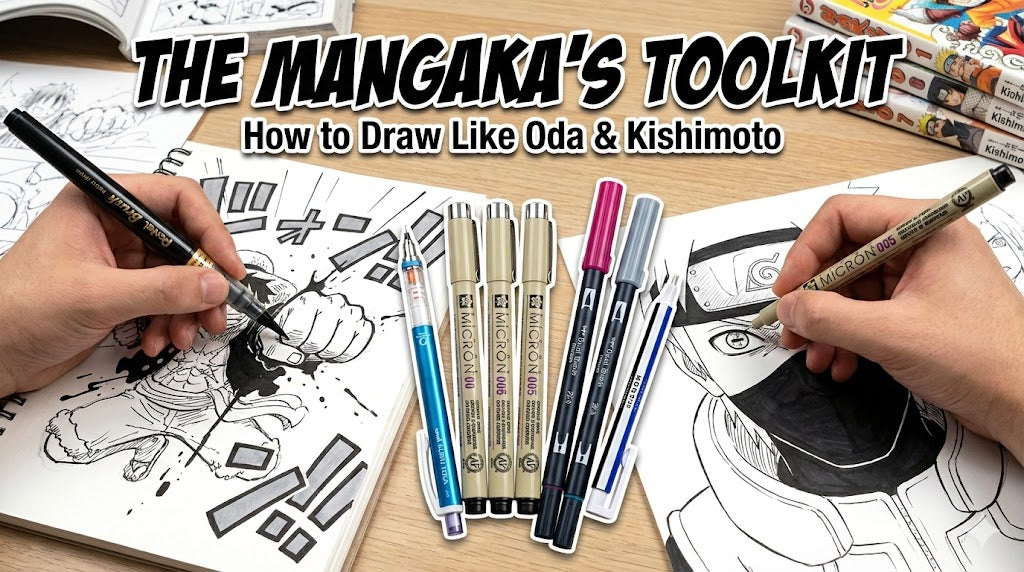
An exhaustive, deep-dive analysis of the tools used by Eiichiro Oda (One Piece), Masashi Kishimoto (Naruto), and Tite Kubo (Bleach)—and the modern alternatives you actually need.
There is a pervasive myth in the artistic community, perpetuated by decades of romanticized documentaries. The myth says that to draw "authentic" Japanese Manga, you must suffer. You must sit in a small room in Tokyo, dipping a scratchy metal nib (the G-Pen) into a pot of messy Kaimei ink, ruining hundreds of pages as you learn to control the flow.
While this image holds a certain nostalgic charm, it is not the only path. The landscape of art supplies has evolved dramatically. The tools available to hobbyists in 2026 are chemically superior, more ergonomic, and far more forgiving than the tools used by the old masters when they started.
Today, we are deconstructing the chemistry, physics, and ergonomics of the "Mangaka's Toolkit." We will analyze why Eiichiro Oda needs a flexible nib for Luffy's dynamic punches, why Kishimoto needs blendable colors for Chakra energy, and most importantly, how you can replicate these effects without spending ten years in an apprenticeship.
Part 1: The Sketch (The Engineering of Graphite)

Every great panel begins with a humble graphite sketch. But for the professional, a standard #2 yellow pencil is the enemy. Why? Because standard pencils are inconsistent.
As you draw with a normal pencil, the graphite tip wears down unevenly. It develops a flat spot. One moment your line is sharp (0.5mm); the next moment, you rotate the pencil slightly, and the line becomes thick and muddy (0.9mm). In the world of Manga, where precision is everything, this is fatal.

The Solution: Uni Kuru Toga ("The Rotating Engine")
The Uni Kuru Toga is not merely a pencil; it is a piece of kinetic engineering. Hidden inside the barrel is a micro-ratchet mechanism.
How it works: Every time you lift the pencil tip from the paper (even for a millisecond), the spring-loaded clutch engages and rotates the lead exactly 9 degrees. This ensures that the lead wears down evenly on all sides, maintaining a perfect, conical point at all times.
Shop Kuru TogaThe Art of Correction (Eraser Engineering)
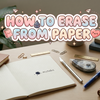
Most beginners focus on the pen, but professionals know the eraser is just as important. A standard block eraser is a blunt instrument. It erases too much.

The Surgeon's Scalpel: Tombow Mono Zero
Imagine you drew a perfect eye, but the eyelash is 1mm too long. If you use a normal eraser, you will wipe out the whole eye. You need the Tombow Mono Zero.
This looks like a mechanical pencil, but instead of lead, it dispenses a 2.3mm ultra-fine eraser core. It allows you to erase a single strand of hair without touching the surrounding art. It is essentially a "White Pencil" that draws negative space.
Shop Mono ZeroPart 2: Inking (The Soul of the Line)
Inking is the moment of truth. If we look at the work of Eiichiro Oda (One Piece), we see lines that are full of energy—they swell and taper. Traditionally, this is achieved with a G-Pen, a metal nib that splits open when you press down. However, G-Pens are notoriously hostile to beginners. They scratch paper, they rust, and if you knock over your ink pot, your carpet is ruined forever.
For the modern artist, the industry standard has shifted to the Sakura Pigma Micron.

The Solution: Sakura Pigma Micron (Archival Ink)
The Micron is not a normal felt-tip pen. It was invented in 1982 to hold "Pigma" ink—the world's first water-based pigment ink. The color particles are large and insoluble. They sit on top of the paper fibers rather than soaking in.
Even Micron ink takes 10-15 seconds to fully cure. NEVER erase your pencil sketch immediately after inking. Wait at least 60 seconds. If the ink is cool to the touch, it is still wet.
- 005 (0.20mm): For eyes, eyelashes, and hair texture.
- 01 (0.25mm): For standard hatching and background details.
- 03 (0.35mm): For main character outlines (faces, clothing).
- 08 (0.50mm): For panel borders and sound effects (SFX).
Part 3: Coloring (The Vibrancy of Kishimoto)
When we think of Naruto, we think of that vibrant orange jumpsuit. Masashi Kishimoto is a master of the "Color Spread." For decades, the professional standard has been Copic Alcohol Markers. But Copics are incredibly expensive.
For the aspiring Mangaka in 2026, there is a water-based alternative that offers the same "Brush Feel" at a fraction of the cost: The Tombow Dual Brush Pen.

The Alternative: Tombow Dual Brush Pens
The Tombow features two tips: a bullet nib for consistent lines, and a large, flexible nylon brush tip. This brush tip mimics the sweeping motion of a traditional Japanese calligraphy brush.
Here is something Tombows can do that Copics cannot easily do: Palette Blending.
- Scribble some dark ink (e.g., Purple) onto a plastic surface (like a CD case).
- Take a lighter pen (e.g., Pink) and pick up the Purple ink with the tip.
- Draw on the paper. The line will start Purple and magically fade into Pink.
This creates a seamless gradient perfect for anime eyes or Chakra energy.
Part 4: The Void (Blacks) & The Fog (Greys)
Tite Kubo (Bleach) is the master of "Negative Space." His art is defined by heavy, solid blocks of black ink (Beta).
The Void: Filling the Black
Do not try to fill in a character's jacket with a 005 Micron pen. You will ruin the pen. Use the Pentel Fude Touch Sign Pen. It allows you to fill large areas instantly.

The Magic of "Screentones" (Without the Sticker)
In traditional Manga, grey shadows are sticky plastic sheets called "Screentones." Applying them is a nightmare of cutting and scraping.
The 2026 Hack: Use a Zebra Mildliner (Grey). It is transparent enough to look like a shadow, but distinct enough to add depth to clothing folds. It is the cheapest, fastest way to add "Pro" shading.
Shop Grey MildlinerThe Spark of Soul: Mastering SFX & Highlights

The soul of a battle scene in Bleach or One Piece lies in the special effects (SFX)—the glint of a katana or the spark of an explosion. Professional mangakas use white ink for these final touches.
Tite Kubo often uses white ink to create atmospheric dust or starfields. You can replicate this by dipping a clean toothbrush into white liquid ink and "flicking" the bristles over your black panels. It creates a chaotic, organic energy that digital brushes struggle to mimic.
The Precision Weapon: Uni-ball Signo Broad (White)
Unlike standard white gel pens that write faintly, the Uni-ball Signo White is ultra-opaque. It is perfect for drawing the "cross" glint in eyes or adding high-contrast reflected light to blades. It effectively acts as a physical "Undo" button for small mistakes.
📜 The Physics of Paper (Don't Ignore This)

You can buy a $500 pen, but if you use it on $0.01 paper, it will look terrible. Paper is the foundation.
- The Problem with Printer Paper: Standard copy paper is 80gsm and porous. It acts like a sponge. When you touch a Micron to it, the ink spreads outward (feathering), ruining your crisp lines.
- The Solution: Bristol Board or Manga Manuscript Paper. You need paper that is at least 150gsm and has a "smooth" finish. Smooth paper prevents the fiber from catching your pen tip, and the thickness prevents alcohol markers from bleeding through.
Ergonomics of the Studio: Protecting the Mangaka

Drawing manga panels is physically demanding. "Mangaka's Back" is a real medical concern. To draw like a pro, you must engineer your environment.
1. The 15° Slant Rule
Drawing on a flat desk causes "Keystoning"—where your brain miscalculates the perspective of a drawing because you are looking at it at an angle. A Drawing Board set to a 15-30 degree slant aligns the paper parallel to your eyes, preventing distorted anatomy and reducing neck strain.
2. High-CRI Lighting (CRI 95+)
Don't use yellow household bulbs. To ensure the "Kishimoto Orange" you color at 2 AM looks the same in sunlight, you need a lamp with a **Color Rendering Index (CRI)** of 95 or higher. It ensures the spectral output of your light matches true daylight.
You love dynamic action, movement, and expressive characters.
• Uni Kuru Toga (0.7mm)
• Pentel Pocket Brush (For bold lines)
You love intricate details, ninja gear, and vibrant colors.
• Sakura Micron (005 for details)
• Tombow Dual Brush (Skin tones)
You love high contrast, cool poses, and minimalism.
• Pentel Fude Pen (Solid Blacks)
• Uni-ball Signo White (Highlights)
Master Style "Parametric" Breakdown
| Artist | Line Philosophy | Best Tool Pairing | Shading Logic |
|---|---|---|---|
| Eiichiro Oda | Exaggerated / Rubber-like | Uni Kuru Toga + Pentel Brush | Hatching & Cross-hatching |
| Masashi Kishimoto | Precise / Clinical | Micron 005 + Tombow ABT | Vibrant Watercolor-style gradients |
| Tite Kubo | Bold / High-Contrast | Pentel Fude + White Signo | Solid Black Beta blocks & Negative space |
| Stage | Old School Tool | Modern Alternative | Why switch? |
|---|---|---|---|
| Sketching | Wooden Pencil (HB) | Uni Kuru Toga | Consistent line width, no sharpening. |
| Correction | Block Eraser | Mono Zero | Surgical precision, protects details. |
| Inking | G-Pen & Pot | Sakura Micron | Archival, waterproof, portable. |
| Coloring | Copic Markers | Tombow Dual Brush | Water-based blending, lower cost. |
| Highlights | White Poster Paint | Uni-ball Signo White | Precision control, zero mess. |
Frequently Asked Questions (7 Common Issues)
Lefties face a unique challenge. The Sakura Micron is your best friend here because Pigma ink dries almost instantly. Avoid glossy gel pens for outlines. Also, consider placing a scrap piece of paper under your hand as a shield.
If your white highlights look grey, it means the black ink underneath wasn't fully dry. The water in the white ink reactivated the black ink. Wait at least 5 minutes before applying highlights.
Entry Level (~$15): 1 Kuru Toga Pencil, 1 Micron (05), 1 Eraser. Perfect for sketching.
Pro Level (~$60+): Full set of Microns (005-08), Tombow Color Set, Mono Zero Eraser, White Ink, and Bristol Paper. For finishing complete illustrations.
Yes. Do not use printer paper. It acts like a sponge and causes "feathering" (fuzzy lines). You need Bristol Board or smooth heavy-weight sketchbook paper (100gsm+) to keep lines crisp and prevent marker bleed-through.
You can practice with it, but it's not recommended for final art. Ballpoint ink is oil-based and reflects light, which scans poorly. It also tends to "blob" on the page. Felt-tip Microns create a matte black line that scans perfectly.
Oil from your skin can smudge graphite and repel ink. Use a "Smudge Guard" glove (like tablet users use) or simply place a clean sheet of paper under your drawing hand. Work from Top-Left to Bottom-Right (if you are right-handed).
Digital is convenient (Undo button!), but traditional art builds muscle memory. Learning to draw a straight line on paper forces your brain to be precise because you can't just hit Ctrl+Z. We recommend starting with paper to build discipline, then moving to digital.
Ready to create your own universe?
Get The Full Mangaka Starter Kit