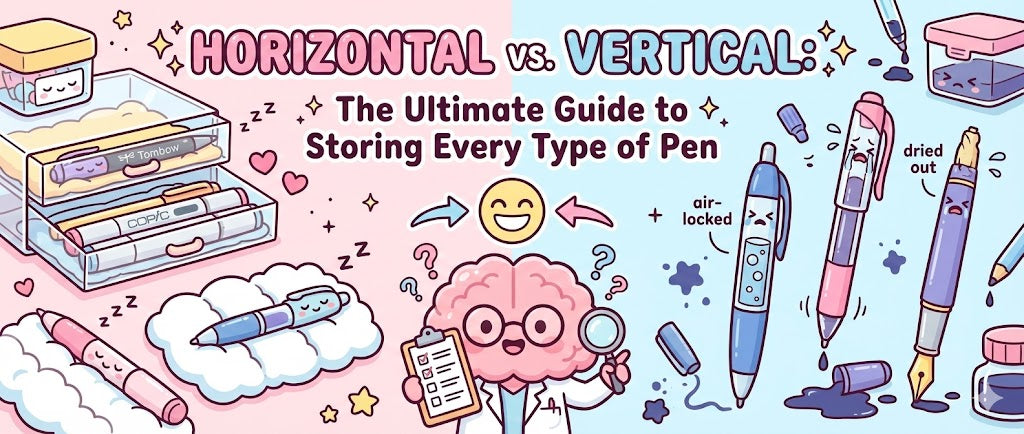
Horizontal vs. Vertical: The Ultimate Guide to Storing Every Type of Pen
This guide is based on long-term personal testing of fountain pens, gel pens, markers, and brush pens used for journaling, planning, and illustration. Storage methods were observed over weeks and months to identify drying, leaking, ink separation, and tip damage.
The Horror Story:
You sit down to journal. You reach for your favorite Tombow Dual Brush Pen—the one you specifically bought for $4 to match your Washi Tape. You uncap it, touch the brush tip to the paper, and... nothing. It's bone dry. But you barely used it! You check the date: you bought it three months ago.
The Verdict: It wasn't bad luck. It wasn't a manufacturing defect. It was gravity. After being stored vertically in a cute pencil cup for several weeks, the marker's internal ink balance was destroyed, leaving the top tip permanently dry while the bottom became overly saturated, eventually leaking enough ink to stain the cap and barrel.
If you are like most stationery addicts, you have hundreds—perhaps thousands—of dollars invested in your collection. You wouldn't leave a $500 violin out in the rain, yet we routinely store $300 worth of markers in the wrong position, causing them to dry out years before their expiry date.
The truth is, pens are not just plastic sticks; they are complex chemical delivery systems. Ink is a liquid, and liquids obey the laws of physics—specifically Gravity, Capillary Action, and Viscosity. If you fight gravity, gravity will win, and your pens will either dry out, leak, or explode.
In this comprehensive guide, Auntie Mei breaks down the science of storage. We will categorize every major pen type into three "Clubs": The Horizontal Club, The Tip-Down Club, and The Tip-Up Club.
Why Your Pens Die No Matter How Carefully You Store Them

To understand storage, you must understand Viscosity. Viscosity is the "thickness" of a liquid—its resistance to flow. In writing instruments, ink viscosity influences flow stability, evaporation speed, and how gravity affects long-term storage behavior.
- Low Viscosity Ink (Water/Alcohol): Flows very easily. Needs to be kept level to prevent it from pooling at one end. Examples: Fountain pens, mildliners, rollerballs.
- High Viscosity Ink (Oil Paste): Flows slowly. Needs gravity to help push it down to the tip, or it won't move at all. Examples: Traditional ballpoint pens.
- Capillary Action: This is the force that pulls ink through the fibers of a felt tip (like a sponge soaking up water). It fights gravity, but it is weak. If gravity pulls the ink down strongly enough, capillary action loses, and the tip dries out.
Flat Is Life: Pens That Must Lie Horizontal
Rule: These pens MUST be stored flat. No exceptions. Buying a vertical stand for these is a death sentence. These storage clubs are defined by ink viscosity, internal reservoir design, and whether gravity assists or disrupts ink delivery over time.
Members: Tombow Dual Brush Pens, Zebra Mildliners, Midori Paintables, Crayola SuperTips.

Why They Die Vertically
These pens have two tips but usually share a single ink reservoir in the middle of the barrel. It's like a tug-of-war.
- If stored Tip-Up: Gravity pulls the ink down to the bottom tip. The top tip loses its ink supply and dries out permanently.
- If stored Tip-Down: Gravity floods the bottom tip. When you finally uncap it, it will be "juicy"—too juicy. It will bleed through your paper, ruin your journal, or even leak into the cap.
The Fix: Store them flat. This keeps the ink balanced in the center, ensuring both tips stay saturated via capillary action. This category works best when ink viscosity is moderate and the pen lacks an internal valve to control flow.
Alcohol Markers
Members: Copic, Ohuhu, Prismacolor, Touch ShinHan.
The Evaporation Problem
Alcohol markers are different. The solvent (alcohol) evaporates much faster than water. Inside the pen is a fibrous material soaked in ink.
If you store Copics vertically, the alcohol solvent can separate from the color pigment. You might pick up a "Blue" marker, but it writes "Grey" because the pigment settled at the bottom while the alcohol stayed at the top. Keeping them flat ensures the mixture stays consistent.
🛍️ Best Storage for Horizontal Pens

The gold standard. Clear drawers force your pens to lie flat while letting you see the colors. Perfect for Tombows.
Perfect for artists on the go. Individual slots keep markers horizontal and prevent them from rubbing together.
Let Gravity Work: Pens That Love Tip-Down Storage

Rule: Let gravity do the work. These pens need help flowing.
Members: Bic Crystal, Uni Jetstream (Oil-based), Parker Jotter.
The Physics of Paste
Ballpoint ink is a thick, oily paste. It does not flow easily. If you store these tip-up, the paste will slowly settle at the back of the tube. When you try to write, the ball will be dry, and you'll have to scribble furiously to get it working again. Storing them Tip-Down ensures the paste is always resting against the ball, ready to write instantly.
Gel Pens (Complex)
Members: Pilot G2, Zebra Sarasa, Pentel EnerGel, Muji Gel Pens.
The "Bubble Lock" Danger
While many gel pens can be stored horizontally, they absolutely CANNOT be stored Tip-Up. Here is why:
Inside a gel pen, behind the ink, there is a clear jelly substance called "Follower Gel." Its job is to act as a plunger, pushing the ink down and stopping it from leaking back.
If you store a gel pen Tip-Up, an Air Bubble can form between the ink and the Follower Gel. Once this bubble enters the mechanism, the pen is "air-locked." It will skip or stop writing entirely, even if there is plenty of ink visible in the tube. Storing them Tip-Down prevents this bubble from ever forming.
🛍️ Best Storage for Tip-Down Pens
Easy access for your daily drivers. Keeps ballpoints primed and ready. Great for desk aesthetics.
Like the Kokuyo NeoCritz. It zips up for travel but stands up like a cup on your desk. The ultimate hybrid.
Keep It Up: Pens That Hate Tip-Down
Rule: Prevent leaks and clogs. Keep the ink away from the opening.

Members: Lamy, Kaweco, Pilot, Sailor.
The Leak Risk
Fountain pen ink is very watery (low viscosity). If stored tip-down, gravity will pull the ink into the cap. Next time you open it, you will have "Ink Hands" (inky fingers). Even worse, the ink can saturate the feed and drip out unexpectedly.
Paint Pens (Valve Action)
Members: Posca, Molotow.
The Sediment Problem
These pens contain heavy pigments that settle (like sediment in a river). Inside the pen, there is a mixing ball (the sound you hear when you shake it). If stored tip-down, the sediment settles into the tip and clogs the valve. Store them tip-up so the sediment settles at the bottom of the tube. Always shake well before use to re-mix.
Protect That Tip: Avoid the Mushroom and Cap Crash
Storage isn't just about direction; it's about protecting the delicate tip.

🍄 The "Mushroom" Effect (Fineliners)
The Crime: Pressing too hard.
The Result: The plastic tip of your Micron spreads out like a mushroom cap. The line becomes thick and fuzzy.
The Fix: Fineliners are designed for zero pressure. Let the pen glide.
💥 The "Cap Crash" (Brush Pens)
The Crime: Hasty capping.
The Result: You miss the center and shove the brush tip into the side of the cap, fraying the bristles permanently.
The Fix: Use two hands. Hold the cap steady. Listen for the "click."
Heat, Light, and Air: Silent Killers of Your Pens
It's not just about gravity. Temperature and light are silent killers.

🔥 Killer #1: Heat (The "Burping" Effect)
Scenario: You leave your pencil case in your car on a hot summer day.
The Physics: Air expands when heated. The air bubble inside your pen barrel expands, increasing pressure. Since the ink cannot compress, the air pushes the ink out of the tip.
Result: An "Explosion" inside the cap. When you open it, ink goes everywhere.
☀️ Killer #2: UV Light (The Fade)
Scenario: You keep your clear acrylic organizer on a sunny windowsill.
The Physics: UV rays break down the chemical bonds in dyes (especially fluorescent highlighters and red inks).
Result: Your Neon Yellow highlighter turns clear. Your Red pen turns pink. Always store pens in the shade.
✈️ Killer #3: Cabin Pressure (Air Travel)
Scenario: You bring your fountain pen on a flight.
The Physics: As the plane climbs, cabin pressure drops. The air inside your pen expands (just like a bag of chips).
Solution: Either fill the pen 100% full (no air = no expansion) or keep it completely empty. Always keep nibs pointed UP during takeoff.
Save Money & The Planet: Refill, Don't Toss
In 2026, throwing away a plastic pen just because the ink is empty is a crime against the planet (and your wallet).
1. The "Light Test": Before trashing a pen, hold it up to a bright light. Is the tube actually empty? Or is the ink just stuck? If there is ink, use the "Hot Bath" trick in Part 8.
2. Buy Refills, Not Bodies: Did you know brands like Pilot, Zebra, and Uni sell ink refills for 60% of the cost of a new pen? The plastic barrel lasts for years. Only replace the inner core.
3. The Fountain Pen Advantage: A fountain pen is the ultimate zero-waste tool. One bottle of glass ink lasts for years and replaces hundreds of plastic disposables.
Bring Dead Pens Back to Life: Emergency Tricks
🚑 Emergency Room: Try these before throwing them away
1. The "Hot Bath" (For Gel/Ballpoints)
If a gel pen has stopped working but still has ink, the ink might be frozen or air-locked. Place the sealed pen (cap on!) in a cup of hot (not boiling) water for 5-10 minutes. The heat lowers the viscosity and can melt dried clogs.
2. The "Centrifuge" (For Air Bubbles)
Tape the string to the tail of the pen. Spin it around your head like a lasso for 30 seconds. The centrifugal force is much stronger than gravity and can push the air bubble out toward the back.
3. The "Alcohol Injection" (For Sharpies/Copics)
If an alcohol marker is dry, remove the rear nib or open the barrel. Inject 2-3 drops of Isopropyl Alcohol (90%+). Let it sit horizontally for 24 hours. This can re-hydrate the dried pigment.
4. The "Water Dip" (For Water-Based Markers)
For dried Tombows or Crayolas, dip the tip in warm water for 15 seconds. Cap it and let it sit for 30 minutes. This often wicks moisture back into the sponge.
Quick Decision: Where Should This Pen Live?
Confused? Use this 3-second decision matrix to decide where to put your pen.
(Horizontal)
Go to Next Question...
(Vertical)
It's a regular pen!
(Standard Ballpoint/Gel)
The Cheat Sheet Every Pen Lover Needs
Screenshot this table. Print it out. Tape it to your desk.
| Pen Type | Example Brands | Best Position | The Scientific Reason |
|---|---|---|---|
| Dual-Tip Markers | Tombow ABT, Mildliner, Midori | ➖ Horizontal | Prevents one tip from drying out while the other floods. |
| Alcohol Markers | Copic, Ohuhu, Prismacolor | ➖ Horizontal | Ensures solvent doesn't separate; keeps nibs juicy. |
| Ballpoint Pens | Bic, Jetstream, Parker | ⬇️ Tip Down | Gravity helps pull the thick, oil-based paste to the tip. |
| Gel Pens | Pilot G2, Sarasa, EnerGel | ⬇️ Tip Down | Prevents "Air Bubble Lock" from forming in the tube. |
| Rollerball Pens | Uni-ball Eye, Pilot V5 | ➖ Horizontal | Liquid ink flows too fast; tip-down can cause leaks. |
| Fountain Pens | Lamy, Kaweco, TWSBI | ⬆️ Tip Up | Prevents leaking into the cap and clogging the feed. |
| Paint Pens | Posca, Molotow | ⬆️ Tip Up | Prevents sediment from clogging the valve mechanism. |
| Fineliners | Sakura Micron, Staedtler | ➖ Horizontal | Keeps pigment consistent; prevents leaks. |
Frequently Asked Questions (FAQ)
We do not recommend it. While Mildliners are durable, long-term vertical storage will cause the top tip to write lighter than the bottom tip. If you have no choice but to use a cup, flip them upside down every week to rotate the ink flow.
You likely stored them "Tip-Up." This allowed air to enter the tip and create an "Air Lock" bubble. Try shaking the pen vigorously (centrifugal force) or soaking the barrel in warm water to get the ink moving again.
No! This is a myth. Cold temperatures can change the viscosity of the ink, making it sludge-like. It can also cause plastic barrels to become brittle and crack. Room temperature (70°F / 21°C) is ideal.
Cabin pressure changes cause ink to expand and leak.
Tip 1: Carry pens that are either totally full or totally empty (less air space = less expansion).
Tip 2: Store them in a sealed Ziploc bag.
Tip 3: Keep them Tip-Up during takeoff and landing.
Possibly. If it dried out due to vertical storage, lay it flat or Tip-Down for 24 hours to let gravity work. If it is water-based, you can briefly dip the dried tip in water to jumpstart the capillary action.
For large collections (especially markers), Acrylic Stackable Drawers are superior. They protect pens from dust, keep them horizontal, and allow you to see exactly what colors you have. Avoid throwing everything into one giant bin.
The graphite core of a pencil is fragile. If you throw pencils into a hard box, they rattle around, shattering the core inside the wood. When you sharpen it, the lead will keep falling out. Use a Pencil Roll or a case with elastic loops to protect them from shock.
If you are an artist, Rainbow is better for creativity. If you are a student or planner, Brand is better because pens of the same brand stack neatly together. Mixing shapes (like a round Copic and a flat Carpenter pencil) wastes space.
Professional artists and stationery enthusiasts typically use these methods:
- Horizontal acrylic drawers for dual-tip markers and alcohol markers
- Clear labels on drawer fronts showing color names or codes
- Rotation habits – using all pens regularly to prevent drying
- Avoiding long-term tip-down storage even for ballpoints (rotating them occasionally)
- Climate control – keeping collections away from direct sunlight and heat sources