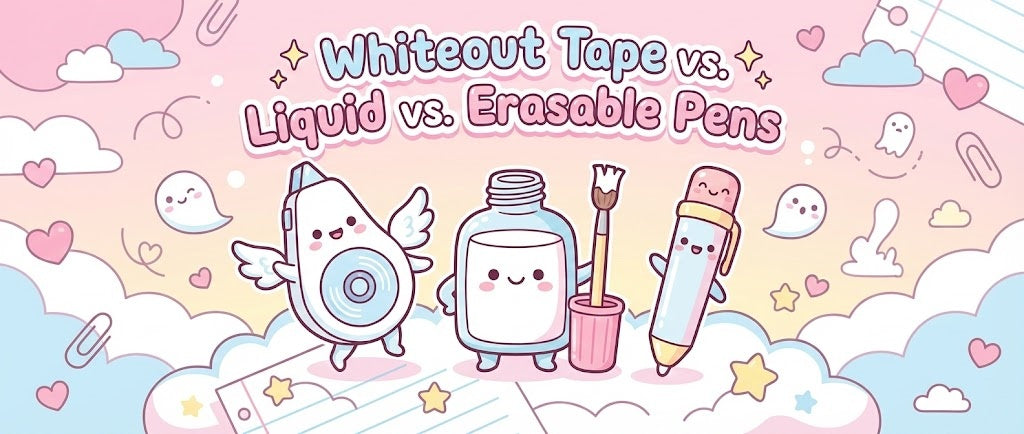
Whiteout Tape vs. Liquid vs. Erasable Pens: The Ultimate Guide to Fixing Mistakes
Written by Auntie Mei — Stationery reviewer with 10+ years of hands-on testing experience in journals, planners, and textbooks • Updated February 2026
We need to talk about "Typo Trauma."
You know the feeling. You are writing a beautiful page of notes. Your handwriting is flowing, your color scheme is perfect, and you are in the zone. You are creating a masterpiece. And then... your hand slips.
You write "thier" instead of "their."
In that split second, the perfectionist in you screams. You face a heartbreaking dilemma. Do you cross it out with a messy black line and ruin the aesthetic of the entire page? Do you tear the page out and start over (wasting 20 minutes)? Or do you reach for a correction tool?

For years, our options were limited to smelly, clumpy white-out bottles that took forever to dry. But in 2026, stationery technology has evolved. We have thermal-sensitive ink that vanishes with friction, cream-colored tapes designed specifically for luxury Japanese paper, and dry-transfer films thinner than a human hair.
But which one should you use? And more importantly, how do you use them without them peeling, cracking, or looking like a "band-aid" on your page?
In this comprehensive guide, we will break down the chemistry, the aesthetics, and the functionality of the three big contenders: Correction Tape, Correction Liquid, and Erasable Pens. Plus, Auntie Mei will teach you how to fix a broken tape runner (yes, it is possible).
This guide is based on years of real-world testing across mass-market notebooks, exam papers, Hobonichi planners, and ultra-thin Tomoe River paper—not just theory.
Contender 1: Correction Tape (The Student Standard)
Mechanism: Dry Transfer Film. A thin layer of white masking pigment is coated on a plastic film tape. When you apply pressure, the pigment transfers from the film to the paper.
Correction Tape (like the iconic Plus Whiper or Tombow Mono Air) is the gold standard for students and office workers for one simple reason: Instant Drying Time. Unlike liquid, which requires you to blow on the page like you are cooling hot soup, tape is dry the moment it hits the paper. You swipe, and you write immediately.
Crucial Knowledge: The "Width" Dilemma
Did you know correction tape comes in different widths? Using the wrong width is why your notes look messy. You need to match the tape width to your notebook's "Rule Height" (Line Spacing).

Best for: Hobonichi Weeks, Grid Paper (3.7mm), Planners. Precision fixing of single letters.
Best for: College Ruled Notebooks (6mm-7mm). This is the most common size found in stores.
Best for: Wide Ruled Paper & Handwriting Practice. Covers large handwriting in one go.
This system of matching tape width to line spacing ensures a professional, seamless correction that aligns perfectly with your text layout.
The "Cream Paper" Crisis
This is where most people fail. If you use a standard, bright-white correction tape on a high-quality notebook like Midori MD, Leuchtturm1917, or Hobonichi, it will look terrible. These notebooks use "Cream" or "Ivory" colored paper to reduce eye strain.
Bright white tape on cream paper looks like a bandage. It screams, "I MADE A MISTAKE HERE!"
Japanese brands (specifically Plus Stationery) manufacture "Cream Colored Correction Tape" (often labeled as for "Kraft Paper" or "Cream Paper"). It blends seamlessly with yellowish notebook paper, making your mistake truly invisible.
After testing cream-colored correction tapes across over 15 premium notebooks, they proved to be the only method that provides an invisible correction on ivory-toned paper without damaging the page surface.
2026 Tech Trend: The "Silent" Mechanism
Have you ever been in a dead-silent library, and your cheap correction tape makes a loud CLICK-CLACK-RAT-TAT-TAT sound as you pull it? It's embarrassing.
Modern 2026 tapes (like the Tombow Mono Air or Kokuyo Campus series) now feature "Silent Gear" technology. They use a special internal damping system that reduces the noise by 50%. You can glide it across the page with a whisper-quiet swish, preserving your dignity and the library's peace.
In short, correction tape is ideal for fast-paced note-taking on smooth paper where immediate re-writing is needed—its instant drying and precision make it the practical choice for students and professionals.
Contender 2: Correction Liquid / Pen (The Artist's Tool)

Mechanism: Titanium Dioxide Suspension. A liquid paint containing pigment, resin, and a solvent (often methylcyclohexane) that hardens when exposed to air.
Many people think correction fluid (the bottle with the brush) is obsolete. It is not. It is simply misunderstood. While it is terrible for taking rapid notes in a lecture, it is essential for artists and Bullet Journalers.
Why use it?
- The "Texture" Cover: Tape works best on smooth paper. If you are using rough watercolor paper or textured cardstock, tape will flake off. Liquid fills in the textured gaps for a smooth finish.
- Precision Highlights: Artists use correction pens (like the Uni Signo White or Pentel Presto) to add "sparkles" to anime eyes or highlights to hand lettering. It's an art supply, not just a mistake fixer.
- Stubborn Ink: Some oil-based markers (like Sharpies) will "bleed through" correction tape over time, turning your white tape purple or black. Liquid forms a harder, thicker shell that blocks bleeding better than thin tape.
In summary, correction liquid remains the superior choice for textured art paper and permanent ink coverage—its ability to create a solid, opaque layer is unmatched by dry tapes.
Contender 3: Erasable Pens (The Magic of Frixion)

Mechanism: Thermo-Sensitive Ink (Metamocolor).
Pilot Frixion pens changed the world when they launched. But do you know how they actually work? The rubber nub at the end is not an eraser. It does not rub the ink off the page like a pencil eraser removes graphite.
The friction creates heat. When the ink reaches approximately 60°C (140°F), the pigment molecules break their bond and become transparent. The ink is still there; it is just invisible.
Because the ink reacts to heat, NEVER use Erasable Pens for:
- Exams: Scanning machines generate heat. Your answers might vanish before the teacher sees them.
- Legal Documents: Signatures, checks, or contracts.
- Mailing Envelopes: A hot delivery truck in summer can erase the address.
The "Freezer Hack" (Magic Trick)
Did you accidentally leave your notebook in a hot car and lose all your notes? Don't panic. Put your notebook in the freezer (-10°C) for 24 hours. The cold will reverse the chemical reaction, and your writing will reappear (though it might be a bit faint).
Ultimately, erasable pens offer the cleanest visual correction by completely removing the error from view, but they require careful consideration of environmental factors and document importance.
Part 4: The Showdown Matrix (Compare & Decide)
Which tool wins? It depends on your scenario. Check the matrix below.
Important:
Paper quality, ink formulation, and pressure vary widely. Always test your correction tools on a back page or scrap paper before committing to your final work.
| Feature | Correction Tape | Correction Liquid | Erasable Pen (Frixion) |
|---|---|---|---|
| Drying Time | ⚡ Instant | 🐢 Slow (30-60s) | ⚡ Instant |
| Writing Surface | Smooth (can be slippery) | Bumpy / Cracks | Perfect (it's paper) |
| Aesthetic | Clean (if color matches) | Messy / White Blob | Invisible (slight ghosting) |
| Exam Safe? | ✅ YES | ✅ YES | ❌ NO (Risk of fading) |
| Long-Term Archival? | ✅ Permanent | ✅ Permanent | ❌ NO (Fades over years) |
The Paper Compatibility Matrix
Not all paper is created equal. Here is how these tools perform on your specific notebook:
| Paper Type | Correction Tape | Correction Liquid | Erasable Pen |
|---|---|---|---|
| Standard A4 / Copy Paper | ⭐⭐⭐ Perfect grip | ⭐⭐⭐ Absorbs well | ⭐⭐⭐ Erases cleanly |
| Ultra-Thin (e.g., Tomoe River 52gsm) | ⭐⭐ Risk of tearing (be gentle) | ⭐ Wrinkles the page heavily | ⭐⭐⭐ Perfect (no ghosting) |
| Coated / Glossy Paper | ⭐ Slips & won't stick | ⭐⭐ Takes longer to dry | ⭐ Smudges easily |
| Textured / Recycled Paper | ⭐ Flakes off the bumps | ⭐⭐⭐ Fills the texture gaps | ⭐⭐ Rubbing may damage paper |
Part 5: Troubleshooting & Advanced Hacks

Correction tape is mechanical, which means it can jam. Before you throw it away, try these fixes.
-
The Loop of Death (Slack Tape):
The tape is hanging out loose. Do not pull it! Look at the back of the dispenser for a small hole or a visible gear. Insert a pen tip or paperclip and turn it counter-clockwise. This manually winds the internal spool and tightens the tape. -
The Snap (Broken Tape):
Did the film snap? You can fix this. Carefully pry open the plastic casing (most snap open). Use a tiny piece of scotch tape to reconnect the broken ends of the film. Wind the slack manually, and snap the case back shut. It works!
Viral Pro Hacks
1. How to Stop Pens from Scratching the Tape
The #1 complaint about correction tape is that rewriting over it looks messy. The secret? Stop using water-based gel pens! Gel ink beads up on the plastic tape film. Always use an Oil-Based Ballpoint Pen (like the Uni Jetstream) to write over tape. It glides perfectly and won't scratch the film.
2. The Frixion "Freezer Magic"
Did you leave your erasable pen notes in a hot car, and now the pages are blank? Don't panic! Place your notebook in the freezer (-10°C / 14°F) for 24 hours. The cold reverses the thermo-sensitive chemical reaction, and your lost writing will miraculously reappear!
Emergency Survival Hacks
What if you have NO tools and made a huge mistake? Don't just scribble a messy black blob.
- The "Washi Patch": Place a strip of solid-color Washi Tape over the error. Write the new word on top using a permanent marker. It turns a mistake into a design feature.
- The "Doodle Rescue": Turn the typo into a drawing. If you wrote an "o" that should be an "a," turn the "o" into a tiny flower or a planet, then write the correct word next to it.
Part 6: Sustainability & The Refill Revolution

Correction tape used to be a plastic waste nightmare—you used it once and threw the whole plastic shell away. In 2026, we do better. Responsible stationery users buy Refillable Correction Tape (like the Plus Whiper MR or Pentel Refillable).
Many people are intimidated by refills, but it is actually a simple 3-step process:
Press the small button on the side or back of the dispenser. The casing will pop open like a clamshell.
Lift out the old, empty cartridge. It usually comes out as one single piece. Recycle this plastic part.
Drop the new cartridge in (it only fits one way). Snap the case closed. You are ready to go!
Part 7: Safety & Health (Parent's Corner)
Old-school liquid whiteout contained Toluene and other harsh solvents that smelled dizzying. Modern 2026 correction tapes and high-quality Japanese liquids (like Pentel) are Solvent-Free and VOC-Free. They are safe for use in classrooms and poorly ventilated spaces, making them the best choice for children.
Part 8: Frequently Asked Questions (FAQ)
Left-handed users often push the tape off the track because standard dispensers are designed for a right-handed "pull." Look for the Tombow Mono Air. It has a flexible head and a low-resistance mechanism ("Air Touch") that allows it to work smoothly even when pushed or held at awkward angles.
Yes, but be gentle. 52gsm Tomoe River paper is delicate. If you press too hard, the sharp plastic tip of the tape runner can tear the paper. We recommend placing a Pencil Board (Shitajiki) under the page to provide a hard surface for smooth application.
Correction tape is essentially a thin layer of plastic film. Water-based Gel Pens (like Pilot G2) and Fountain Pens struggle to grip onto the plastic; they will bead up and smear. For writing over tape, we strongly recommend using an Oil-Based Ballpoint Pen (like a Jetstream) or a Felt Tip Fineliner.
No. It is "Not Archival Safe." If you are writing a diary you want your grandchildren to read, or signing a mortgage, do not use Frixion. The ink will fade naturally over time or if exposed to sunlight.
If you use standard copy paper, any tape works. If you use Leuchtturm1917, Midori MD, or Moleskine, standard tape looks too bright. Search specifically for "Cream Correction Tape" (Plus Stationery makes the best version called "Whiper Petit Cream").
You can try! There are dedicated "Correction Fluid Thinners" available at art stores. In a pinch, a tiny drop of nail polish remover (acetone) might work to re-liquify it, but this can affect the opacity and smell.
Yes. If stored for years, the adhesive can dry out, causing the tape to flake off the film rather than stick to the paper. If you find a 5-year-old tape in a drawer, test it on scrap paper first.
Only cream-colored, low-adhesion correction tape should be considered—and testing is essential. For Bible pages or delicate paper, consider using a removable overlay or pencil instead to avoid any risk of damage or show-through.
Pencil or removable overlays are safest. Erasable ink is not archival. For permanent corrections on important documents, archival-quality correction tape or liquid that is specifically labeled as acid-free and permanent is recommended.
About the Author
Auntie Mei is a stationery reviewer specializing in annotation systems, correction tools, and aesthetic study methods. Her guides are built from hands-on testing across planners, textbooks, exam papers, and archival journals.
Make Mistakes vanish (Stylishly)
Don't let a typo ruin your perfect page. Upgrade your toolkit today.
(Pro Tip: Grab the Cream Tape if you use fancy notebooks!)
Shop Correction Tools