
Is Writing by Hand Better for You? The Neuroscience of the "Analog Advantage" (2026 Guide)
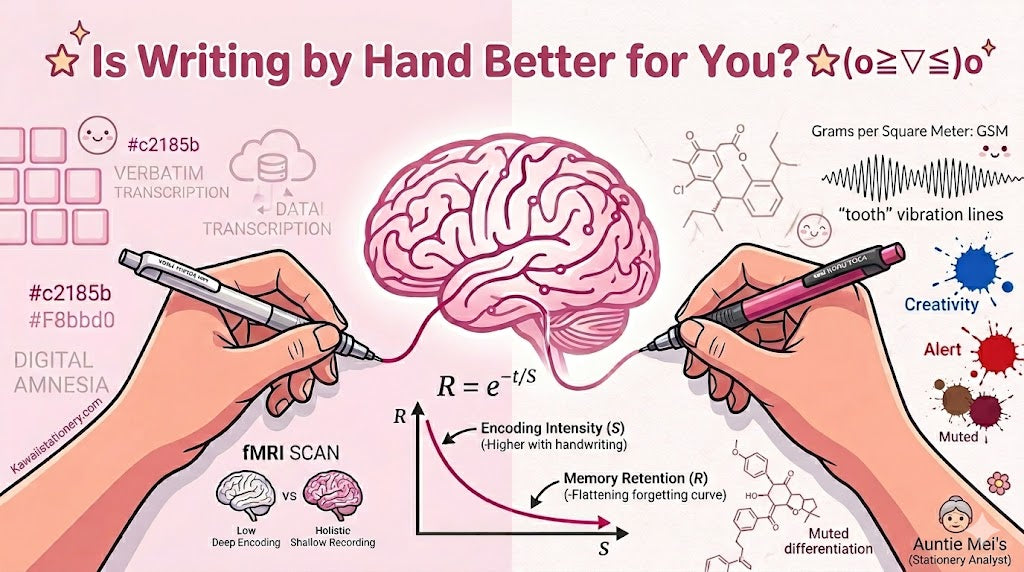
In the high-speed digital ecosystem of 2026, we have collectively outsourced our memory to the cloud. We dictate our thoughts to AI assistants, we type 90 words per minute on whisper-quiet mechanical keyboards, and we capture complex meeting notes with a single screen tap. But as we have gained unprecedented speed, we have sacrificed depth. A silent epidemic is spreading across modern offices and universities—a neurological phenomenon that cognitive psychologists are now classifying as "Digital Amnesia."
Have you ever spent two hours typing perfect, heavily formatted lecture notes or meeting minutes, only to realize later that afternoon that the information has entirely evaporated from your mind? You are not losing your memory; you are simply using the wrong interface for learning. A computer keyboard is, at its core, a transcription device. A pen, however, is a cognitive encoding device. Today, we are going deep into the biological, physical, and psychological reasons why handwriting is the ultimate "brain hack" for the 21st century.
1. The Neuro-Motor Loop: Your Hand as a Memory Encoder

From a biological perspective, typing is considered a "shallow" motor task. Whether you press the letter 'A', the letter 'S', or the 'Enter' key, the physical movement is virtually identical: a downward press of a finger. Your brain views this as a simple, repetitive selection process. It does not need to engage high-level processing to execute it.
Handwriting, conversely, requires a massive level of Sensory-Motor Integration. To write a complex word like "Creativity," your hand must dynamically coordinate 27 bones, over 30 muscles, and thousands of microscopic nerve endings to draw unique, overlapping shapes. This extreme complexity forces the brain to build a "Tactile Index" for the information. You aren't just remembering the definition of a word; you are remembering the precise physical effort it took to drag ink across paper to create it.
The Reticular Activating System (RAS) & Memory Decay
Handwriting triggers the Reticular Activating System (RAS) located at the base of your brain. The RAS acts as a high-level biological filter for the millions of bits of data hitting your consciousness every second. By engaging the fine motor skills of the hand, you send a direct neurological signal to the RAS: "This specific piece of data is a survival priority. Keep it."
Mathematically, we can model human memory retention (R) as an exponential decay function, which is heavily influenced by the encoding intensity (S) and elapsed time (t):
Because handwriting is slower and physically demands more from the parietal lobe than typing, the encoding intensity variable (S) is significantly higher. By writing by hand, you are effectively flattening the forgetting curve. You trade immediate transcription speed for permanent neural pathways.
2. The Physics of Paper: Why GSM and "Tooth" Matter

If handwriting is about physical feedback, then the surface you write on is just as important as the pen you hold. A common mistake beginners make is buying cheap, 70gsm (Grams per Square Meter) printer paper. This paper is overly smooth and highly porous. It provides zero structural feedback to the pen tip.
In the premium stationery world, Japanese engineers design paper with a specific microscopic texture known as "Tooth." When you drag a metal nib or a graphite core across Midori MD Paper (which is highly regarded for its tactile feedback), it creates a microscopic vibration. This vibration travels up the pen, through your fingers, and into your nervous system. We call this Tactile Frequency.
This friction prevents the brain from entering "autopilot" mode. It forces a micro-pause between thought and physical execution, allowing for deeper synthesis of the material. Too much smoothness causes the brain to disengage; perfectly calibrated friction keeps the brain anchored to the present moment.
📐 The Dimensions of Thought: Spatial Cognitive Boundaries

Beyond texture, the physical size of your paper directly dictates the breadth of your thinking. Brain imaging shows that our "spatial cognition" adjusts to physical borders. An A5 notebook provides structured, logical boundaries perfect for sequential reasoning, lists, and daily planning. However, when you need divergent, expansive thinking—like brainstorming a new project—the larger, uninhibited boundaries of a B5 or A4 unlined sketchbook allow your brain's spatial mapping to spread out. Your cognitive architecture physically expands to fill the borders of the page.
👃 The Hidden Pathway: The Olfactory Anchor
Tactile friction and spatial mapping aren't the only analog advantages. High-quality papers (like Midori or Tomoe River) and specific traditional inks emit a faint, distinct scent of wood pulp and subtle carbon. Biologically, the olfactory nerve is the only sensory pathway that bypasses the thalamus and wires directly into the limbic system (the brain's emotional and memory center). This creates an "Olfactory Anchor." When you open that familiar notebook, the subtle scent of paper instantly pulls your brain back into a state of deep, focused flow.
Engineered for Focus: The Uni Kuru Toga
For those who find standard wooden pencils too messy but still crave the "tactile drag" that aids memory, the Uni Kuru Toga is an engineering marvel. Its internal micro-ratchet engine rotates the lead every time it touches the paper, providing a consistently sharp 0.5mm line and a specific, satisfying resistance that keeps your brain engaged during marathon study sessions.
Boost Your Retention with Kuru Toga3. Color Psychology: Stimulating the Amygdala

When we type on a screen, we usually look at uniform black text on a white background. It is clinical and sterile. However, cognitive research shows that memory retention is deeply tied to emotional arousal, which is processed in the brain's Amygdala.
Handwriting allows for instant, intuitive color-coding, which acts as a visual trigger for memory retrieval.
🎨 The Science of Ink Color
- Blue Ink: Proven to enhance creativity and calm the nervous system. Ideal for brainstorming and expansive thinking.
- Red/Warm Inks: Increases alertness and attention to detail. Perfect for underlining critical errors or deadlines, but should be used sparingly to avoid inducing anxiety.
- Vintage/Muted Tones (e.g., Zebra Sarasa Vintage Colors): These lower the harsh contrast on the page, reducing eye strain during long study sessions while still providing enough color differentiation to categorize information (e.g., using Sepia for historical dates and Bordeaux for vocabulary definitions).
4. The Sociological Conflict: The "No Undo" Effect

Perhaps the most profound benefit of handwriting in 2026 is psychological. Digital environments are built entirely on the foundation of the "Backspace" and "Undo" (Ctrl+Z) keys. While convenient, this creates a psychological safety net that actually stifles raw creativity.
When you know you can erase a sentence instantly, your "Internal Critic" remains constantly active. You edit your thoughts before they are even fully formed on the page. You write, delete, write, and delete, trapped in a loop of perfectionism.
Paper is wonderfully unforgiving. When you put a permanent gel pen or a fountain pen to a notebook, you are forced to commit to your thought. This lack of an undo button lowers your creative inhibition. You stop trying to be "perfect" and start being "authentic." This is why world-class architects, authors, and designers still sketch their initial concepts in notebooks before moving to CAD software or word processors.
💡 The "Messy Page" Advantage
A messy, scribbled-over page in a paper planner provides more visual cues for memory than a pristine, formatted digital document. Your brain uses spatial memory—the ink blobs, the crossed-out words in the top right corner, the doodle in the margin—as mental landmarks to retrieve the information later.
5. Mental Health: The Analog Detox & Biological Feedback
By 2026, "Digital Fatigue" is a recognized occupational hazard. We stare at screens for work, for socializing, and for entertainment. Writing by hand is one of the last remaining "Offline Rituals."
The act of physically closing your laptop and opening a thick, lay-flat notebook creates a physical sanctuary. There are no pop-up notifications, no unread email badges, and no algorithms fighting for your attention. Journaling for just 10 minutes before bed acts as a cognitive off-ramp. It allows you to externalize your anxieties—moving them from the cyclical loop in your mind onto a physical substrate that you can close and walk away from, significantly lowering cortisol levels and improving sleep architecture.

✅ Biological Feedback Journaling (The Dopamine Spike)
In our high-stress environment, the physical act of crossing off a task provides a massive dopamine spike. Clicking a digital checkbox on a screen is frictionless and clinically sterile. Taking a pen and aggressively striking a thick line through a completed task provides tactile resistance, visual finality, and a surge of biological dopamine that a digital screen simply cannot replicate.
🧠 The fMRI Perspective: A Tale of Two Brains
If you were to look at an fMRI brain scan of someone typing on a keyboard, you would see localized, weak flashes of activity primarily in the motor cortex and the language centers. It is a low-energy, highly efficient, but cognitively "dim" state.
Now, look at the scan of someone writing by hand. The brain literally lights up like a fireworks display. The visual cortex (tracking the wet ink), the motor cortex (coordinating the complex hand movements), and the amygdala (processing the emotional weight of the physical effort) all fire simultaneously. This massive, holistic neural activation is the biological definition of "Deep Encoding" versus "Shallow Recording."
| Cognitive Dimension | Handwriting (Analog) | Typing (Digital) | The Scientific Winner |
|---|---|---|---|
| Neurological Activation | Engages visual, tactile, and complex motor-planning regions simultaneously. | Relies on simple, repetitive muscle memory and basic spatial mapping. | Handwriting (Creates denser neural networks) |
| Information Synthesis | Slower speed forces the brain to summarize, paraphrase, and digest concepts in real-time. | High speed encourages verbatim transcription without actual comprehension. | Handwriting (Promotes deep understanding) |
| Focus & Flow State | Zero digital noise. Creates a single-tasking environment. | Vulnerable to multitasking, tab-switching, and notification interruption. | Handwriting (Sustained attention) |
6. The Physics of "Hand Cramps": Relearning the Ergonomic Grasp

A common complaint in 2026 is: "Writing by hand hurts my wrist." Because millennials and Gen Z have spent decades typing and swiping, the intrinsic muscles of the hand have actually atrophied. Hand cramps are not a sign that handwriting is bad; they are a sign of muscular deconditioning.
Do not let temporary muscle fatigue force you to abandon your cognitive evolution. The solution is Ergonomic Physics. By switching to a pen with a large-diameter, shock-absorbing grip (such as the Pilot Dr. Grip series), you drastically reduce the pinch-force required to hold the instrument. Choosing an ergonomic barrel is about lowering the physical barrier of entry so you can maintain a state of "Flow" for hours without micro-trauma to your tendons.
7. The 2026 Hybrid Workflow: Marrying Analog and Digital

Auntie Mei isn't suggesting you throw your tablet into the ocean. The most productive minds of 2026 use the Hybrid Method. You must use tools for what they are best at: Paper for thinking, and Digital for storing.
- Phase 1: The Analog Draft. Use a notebook and a fast-drying pen for brainstorming, complex problem solving, and initial meeting notes. Let your brain benefit from the tactile encoding.
- Phase 2: The Digital Archive. At the end of the week, use an OCR (Optical Character Recognition) app to scan your notes into your digital system.
The "Scan-Ready" Ink: Pentel EnerGel
If you plan to digitize your handwritten notes, you cannot use cheap, faded ballpoint ink. Scanners need high contrast. Use the Pentel EnerGel to maintain deeply saturated, pure black lines, making it effortless for 2026's AI-enhanced note-taking software (like Notion AI or Obsidian) to index your manuscripts. This is the ultimate process of your 'analog brain' feeding raw nutrients to your 'digital brain'.
Shop Pentel EnerGelAuntie Mei's "Analog Prescriptions" for 2026
Match your cognitive goal with the correct physical tool.
📚 The Student
(High-Volume Retention)
Prescription: Uni Kuru Toga (Constant resistance) + Kokuyo Campus High-Friction Paper.
Why: Prevents brain-wandering during massive information intake by maintaining a steady physical drag that keeps the RAS active.
🎨 The Creative
(Divergent Thinking)
Prescription: Pentel Brush Pen + Seamless Large Format Notebook (e.g., Leuchtturm1917 or Midori A4).
Why: Fluid strokes and unbound borders allow spatial mapping and lateral thinking to run wild without hitting a restrictive edge.
🧘 The Anxious Mind
(Digital Detox)
Prescription: Glass Dip Pen or Fountain Pen + Textured Cotton Paper.
Why: The deliberate, slow ritual of dipping ink and feeling the heavy paper texture grounds the nervous system and forces extreme mindfulness.
Frequently Asked Questions
Technically, typing is faster for recording data, but handwriting is significantly faster for learning it. Because you cannot write as fast as a professor speaks, your brain is forced to actively listen, summarize, and synthesize the information in real-time. This active processing is the foundational step of deep memory retention.
Yes. Research in Haptic Perception confirms that the physical feedback (the slight resistance or "tooth") of the pen on paper plays a critical role in cognitive engagement. A pen that writes with a tiny amount of friction keeps the brain anchored and focused, whereas an overly slippery stylus on a glass tablet can cause the brain to disengage.
Absolutely. The neurological benefits derive from the physical act of forming the letters and the motor-planning involved, not the aesthetic beauty of the final result. Your brain works just as hard (if not harder) to produce "chicken scratch" as it does to produce elegant calligraphy. The encoding still happens.
They are a close second, but they are not identical. The major difference is friction. The lack of drag on a glass screen alters the motor feedback loop. For maximum retention, the unique physical interaction with paper fibers is still superior. If you must use a tablet, applying a matte, "paper-feel" screen protector can help simulate this necessary friction.
Clinical studies indicate that as little as 10 to 15 minutes of "Expressive Writing" (freely dumping your thoughts, anxieties, or gratitude onto paper) before bed can significantly reduce circulating cortisol levels, calm the nervous system, and improve overall sleep architecture.
Paper has no backspace key. This lack of instant editing capability essentially mutes your "Internal Critic." Without the option to constantly revise and delete as you go, you enter a more free-flowing, uninhibited state of "Brain Dumping," which is essential during the early ideation phases of any creative project.
For serious studying, you want paper with high opacity to prevent "ghosting" (seeing the ink from the other side of the page). Look for Japanese paper between 80gsm and 105gsm. Minimizing ghosting ensures your visual cortex isn't distracted by background noise, keeping 100% of your processing power focused on the current page.
"In 2026, the ultimate luxury is no longer computing power, but focus. Every scratch of the nib across the page is a declaration of reclaiming your cognitive sovereignty. Stop merely 'storing' your life; start 'encoding' it."
Explore High-Performance Stationery


)