Beyond the Silver Wire: The Ultimate Guide to Aesthetic & Kawaii Paper Clips
Let’s be brutally honest: the standard silver office paper clip is a menace to stationery lovers. It snags on delicate paper fibers, leaves ugly crimp marks on your expensive Hobonichi pages, and eventually rusts, permanently staining your memories. We spend hours curating the perfect fountain pen inks, the smoothest Tomoe River paper, and the most aesthetic washi tapes, only to bind them together with a cheap piece of galvanized wire born in a sterile corporate factory.
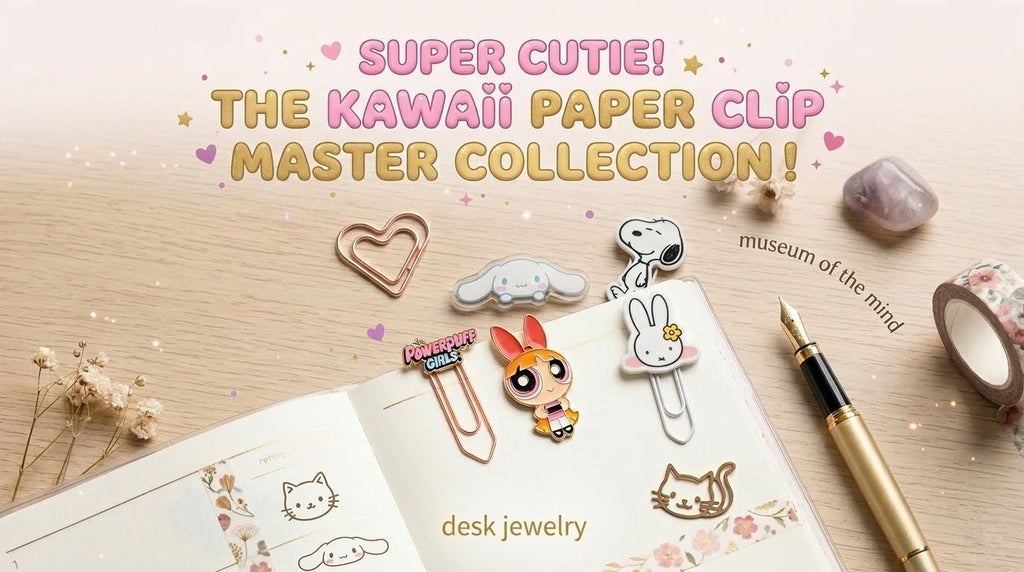
In 2026, the paper clip is no longer just a utilitarian tool to hold tax documents together. It is a Planner Bookmark, a Junk Journal Focal Point, and an extension of your desktop aesthetic. However, not all cute clips are created equal. Some are too heavy, some are too flimsy, and some are just plain annoying to use.

The 1899 Gem Clip vs. The 2026 Aesthetic Revolution
To understand why we need better clips, we must look backward. The standard double-oval clip we all know (The "Gem" clip) was popularized around 1899. It was designed for one thing: mass manufacturing. It was never designed to respect the integrity of the paper. For over a century, we accepted that "paper damage" was just the cost of organization.
But the modern journaling renaissance changed everything. When you are writing a Watchman's Journal or creating a vintage ephemera spread, you are not just "filing papers." You are building a Museum of the Mind. The tools you use to bind these memories must be as intentional and beautiful as the memories themselves. This is why the Japanese and Korean stationery markets revolutionized the clip, turning it from an "office supply" into "desk jewelry."
The Physics of Paper Trauma (Why Cheap Clips Ruin Journals)
Why exactly does a standard paper clip leave a permanent indent on your paper? It comes down to basic physics and the concept of mechanical pressure.
P = F / A
In this formula, Pressure (P) equals the clamping Force (F) divided by the Area of contact (A). A cheap wire clip has a tiny surface area (a thin wire). Therefore, all the tension force is concentrated into a microscopic line, resulting in massive pressure that crushes the cellulose fibers of your paper. Furthermore, uncoated steel undergoes rapid oxidation (rusting) when exposed to the microscopic moisture and oils from your fingers.
Aesthetic clips combat this in two ways: 1. Wider surface areas (like Binder clips or die-cut characters) to distribute the force (A increases, so P decreases), and 2. Protective coatings (Enamel, Rose Gold Electroplating, or Vinyl) to eliminate the oxidation reaction entirely.

Today, Auntie Mei is pulling back the curtain. I am going to review the top 7 aesthetic clips and accessories from our collection. I won't just tell you why they are beautiful—I will tell you exactly what their flaws are, their manufacturing secrets, and how to style them, so you can choose the perfect tool for your specific paper type. Finally, stick around for the end where we answer the Internet's most burning (and surprisingly scientific) questions about the physics of paper clips.
Part 1: The Vintage & Elegant Edition
A must-have for the Junk Journaling community. These brass-toned clips bring instant "Wabi-Sabi" (the beauty of aged imperfection) to any spread. They are heavy-duty and designed to hold thick stacks of watercolor paper or layered ephemera flat while you work.

✔️ Auntie's Pros
- Incredible clamping force; keeps thick journals perfectly flat for overhead photography.
- The antique finish looks stunning in flat-lay photos and won't show oily fingerprints.
- Indestructible alloy build—these will outlast your notebooks.
⚠️ Auntie's Warning
- They have a bite! The grip is so strong that leaving them on thin paper (like 52gsm Tomoe River) for days will leave a permanent dent. Only use on watercolor paper or the thick cover of the notebook itself.
- Requires substantial hand strength to squeeze open compared to plastic clips.
The ultimate romantic touch. These are Auntie Mei's top recommendation for sealing Pen Pal letters, attaching photos to wedding invitations, or simply adding a touch of soft, luxurious elegance to your daily planner.

✔️ Auntie's Pros
- Premium rose gold electroplating means zero rust, ever.
- Instantly elevates the perceived value and emotional warmth of any document or letter.
- The smooth, rounded wire curves glide effortlessly over delicate paper without snagging.
⚠️ Auntie's Warning
- Form over function. Because of the heart shape, the tension wire doesn't grip as deeply or as securely as a long oblong clip. They are perfect for holding 2 to 4 sheets of paper together, but they will easily slip off thick stacks.
Part 2: The Micro-Dopamine Hit (Character Clips)
Sometimes, you just need a little friend smiling at you from the top of your textbook. These character clips are perfect for students and professionals who need a quick hit of "Micro-Dopamine" during a stressful study session. They function brilliantly as top-page index tabs.

✔️ Auntie's Pros
- Highly visible. Perfect for marking "Start Here" or "Important Deadline" pages.
- The characters are made of durable, smooth acrylic/resin materials that won't scratch your hands or snag your sweater.
- A great conversation starter in a boring office or classroom.
⚠️ Auntie's Warning
- Top-heavy design! Because the large character sits at the very top of the metal clip, if you clip them to a single sheet of flimsy copy paper, the page might fold or flop over from the weight. Best used on thicker cardstock dividers or a small stack of pages.
Bringing back pure Y2K nostalgia. These vibrant enamel-coated clips are loud, proud, and perfect for clipping polaroids to a wire grid board or adding unapologetic retro flair to a daily bullet journal spread.

✔️ Auntie's Pros
- Thick baked enamel coating completely protects the paper from the metal wire underneath.
- Massive style points; they capture the bold, colorful aesthetic of the 90s and 2000s perfectly.
- Very sturdy construction; the enamel bonding reinforces the metal clip structure.
⚠️ Auntie's Warning
- They add "chunk." If you are trying to keep a minimalist, perfectly flat notebook (like a slim Stalogy), these will add noticeable bulk and create an uneven writing surface when you close the book.

Wait, a hair clip in a stationery guide? Absolutely. Deep journaling requires entering a "Flow State." Nothing breaks concentration faster than hair falling into your eyes or brushing against wet fountain pen ink. Pinning your hair back is the physical ritual that tells your brain: "The world is paused. It's time to focus."
✔️ Auntie's Pros
- Designed with flat bases to hold hair securely without leaving annoying creases or dents (unlike standard hair ties or claw clips).
- Makes a beautiful, cozy prop for your desk flat-lay photos for Instagram or Pinterest.
⚠️ Auntie's Warning
- Do NOT use on paper! The hinges and teeth are designed for hair volume and tension. If you force this onto a stack of paper or a notebook cover, you will permanently stretch the hinge and ruin the clip. Keep it on your head!
Part 3: The Pinnacle of Japanese Precision

Midori is the holy grail of Japanese stationery engineering. These "Nano" clips are laser-cut from high-quality steel into the shape of tiny, elegant cats. The sliding matchbox-style packaging is a masterclass in minimalist organization, designed to sit unobtrusively on an architect's or designer's desk.
✔️ Auntie's Pros
- Zero fiber damage. Engineered with a precise tension curve to slide onto paper without scratching, tearing, or crimping.
- Micro-sized (Nano), so they don't cover up your text, block your handwriting, or clutter the page visually.
- The eco-friendly sliding paper box is deeply satisfying to open and close.
⚠️ Auntie's Warning
- They are TINY. We mean it. If you drop one on a thick shag carpet, it belongs to the carpet now. You will not find it.
- Strictly for 1 to 3 sheets of paper. Do not force them onto thick cardstock or laminated pages, or they will bend out of shape permanently.
Part 4: 10 Advanced Journaling Hacks Using Aesthetic Clips

Now that you have beautiful tools, how do you use them beyond simply holding two pieces of paper together? Here are Auntie Mei's top secret methods for maximizing your clips in your creative journals:
- The "Hidden Tip-In": If you make a mistake on a page, don't tear it out. Write a new entry on a beautiful piece of vellum or translucent tracing paper, and use a Rose Gold Heart clip to attach it directly over the mistake. It becomes an interactive "flap" that adds mystery to your journal.
- The Emergency Pen Loop: Don't have a pen loop on your notebook? Take a large Binder Clip, attach it to the back cover of your journal, and slide the pocket clip of your pen through the silver metal arms of the binder clip. Instant, secure pen holder.
- The Shaker Dashboard Maker: Take a clear plastic sleeve, fill it with sequins or glitter, fold the top over, and seal it shut with three brightly colored Powerpuff Girls clips. You've just created a removable, interactive "shaker dashboard" for your planner.
- The Watercolor Stretching Hack: When painting in your journal, use 4 heavy Vintage Binder Clips (one on each corner) to pin the page down to the backing board. This prevents the paper from warping and buckling when it gets wet.
- The Receipt Catcher: If you use a Traveler's Notebook for financial tracking, dedicate the inside front cover as the "Inbox." Keep a large Sanrio clip there. Every time you get a receipt, immediately clip it there until Sunday, when you process your budget.
- The Washi Tape Bobbin: If you are traveling and can't bring full rolls of washi tape, wrap 10-20 loops of tape around the wide, flat black body of a Binder Clip. It acts as a perfect, flat travel bobbin!
- The "Today" Marker: Instead of ribbon bookmarks which fray and get dirty, place a Midori Nano Cat clip on the top edge of your current daily page. It sticks out just enough to let your thumb instantly flip to the right day.
- The Privacy Lock: Have a page of intense, private journaling you don't want anyone accidentally flipping to? Fold the page in half vertically, and seal the edge with three aesthetic clips. It signals to others (and yourself) that this page is closed.
- The Instant Photo Frame: Want to add a polaroid but hate glue? Cut a square frame out of thick cardstock, place it over the photo, and use four mini clips on the corners to hold the frame and photo to the journal page. It looks highly stylized and industrial.
- The Drying Rack: If you use heavy wet inks or watercolors and need to turn the page, use a large binder clip to prop the wet page up vertically, allowing the air to circulate and dry the ink faster without smudging onto the opposite page.
The Physics & Science of the Paper Clip (The Ultimate FAQ)
Auntie Mei gets asked a lot of surprisingly scientific questions about stationery. For the students out there doing physics and chemistry homework (or incredibly curious journalers), here are the hard facts and mathematical truths about the humble paper clip:
Standard office paper clips are made of cheap, uncoated galvanized steel wire. Steel is an alloy of iron and carbon. When iron is exposed to ambient humidity and the natural oils from your fingers, it undergoes an oxidation reaction (4Fe + 3O₂ + 6H₂O → 4Fe(OH)₃), commonly known as rust. This is why cheap clips stain your pages brown over time. Premium aesthetic clips (like our Rose Gold or Enamel character clips) are made out of rust-resistant alloys (like brass) or feature a thick vinyl/electroplated coating to permanently protect your delicate planner pages from this chemical reaction.
Yes, absolutely! Because standard paper clips and binder clips are primarily composed of steel (which contains iron), they are highly ferromagnetic. This means they are strongly attracted to magnets. This is actually a brilliant desk organization hack: you can use a magnetic dish, a magnetic wand, or even a strong magnet glued to the underside of your shelf to instantly collect and suspend your aesthetic clips off your desk without them spilling everywhere in a drawer.
A bare metal steel clip is an excellent electrical conductor. We can understand a material's electrical resistance (R) using the fundamental physics formula:
R = ρ L / A
Because steel has a very low resistivity (ρ), electrons can flow freely from one end of the clip to the other. However, this is where stationery gets tricky! Many of our Kawaii Clips feature thick baked enamel, plastic, or resin character toppers. These coatings are molecularly dense and lack free electrons, meaning they act as powerful insulators. *(Auntie Mei's Strict Warning: Please stick to journaling and do NOT use our cute Snoopy clips to complete high-voltage battery circuits in your science class!)*
A standard 33mm steel paper clip weighs exactly 1 gram. This is a universally accepted fun fact, and science teachers frequently use paper clips as a cheap, standard 1-gram weight to teach students how to calibrate digital scales! We can prove this by looking at the density of steel (ρ ≈ 7.85 g/cm³) and calculating the volume of the wire. However, our heavy-duty Vintage Metal Binder Clips weigh significantly more (often 10-15 grams each), providing the substantial physical "gravitas" needed to hold thick notebooks open against the tension of the spine binding.
A standard #1 office clip is typically 3.3 cm (33 mm) long. But in the world of aesthetic stationery, size strictly follows function! Our Midori Nano Cat Clips are micro-sized (around 1.5 cm or 15 mm) specifically engineered for subtle page-marking without adding bulk. Conversely, our Sanrio Character Clips are jumbo-sized (over 4.5 cm or 45 mm) designed to protrude from the top of the book to serve as prominent, easily grabbable bookmarks.
Right here! If you are finally ready to stop damaging your precious journals, planners, and letters with boring, rusty wire, you must upgrade your tools. You can explore our entire curated collection of Japanese micro-clips, retro binder clips, and pop-culture character clips directly at My Kawaii Stationery. We ship globally to ensure your desk setup is flawless.
Thin, premium fountain-pen-friendly paper (like 52gsm Tomoe River or Midori MD) is incredibly delicate. Traditional tight steel clips will leave permanent crimp marks because the pressure (P) is too high. To prevent this, Auntie Mei recommends using our Midori D-Clips which are engineered with a specific, relaxed tension curve, or sliding a small folded piece of scrap vellum paper under the clip to act as a physical buffer between the metal and your journal page.
Stop Settling for Silver Wire
Your journals, your planners, and your handwritten letters are the physical archives of your life. Treat them with the respect they deserve. Upgrade your desktop aesthetic with tools that are as beautiful as they are functional, and never let a rusty clip ruin your memories again.
Shop The Aesthetic Clip Collection