The Ultimate Fountain Pen Guide: Nib Types & Cleaning Hacks Explained
We have all been there: you buy a cheap plastic ballpoint pen, use it for a month, it inevitably dries out or starts skipping, and you throw it in the trash. It is a frustrating, wasteful, and expensive cycle over a lifetime. Entering the world of fountain pens changes absolutely everything. A good fountain pen isn't just a writing tool; it is a personalized heirloom. Because the metal tip slowly micro-polishes itself to match your specific writing angle and hand pressure, a fountain pen literally becomes uniquely yours the more you use it.

🌿 The 2026 Eco-Imperative: Your Carbon Footprint
Beyond the aesthetic writing experience, a fountain pen is a powerful environmental statement. Over 5 years, a student or professional will easily consume and discard over 100 plastic gel pens, contributing heavily to global microplastic pollution. A single high-quality fountain pen, paired with recyclable glass bottles of ink, effectively reduces your writing carbon footprint by over 95%, turning a daily chore into an act of profound social responsibility.
Furthermore, you break free from the prison of standard blue and black ink. With a fountain pen, you can refill the reservoir with thousands of stunning bottled inks—from deep shading teals to shimmering golds and waterproof iron galls.
However, the fountain pen world can be incredibly intimidating for beginners. You are immediately bombarded with confusing acronyms like "EF," "Stub," or "Architect Nibs," and you hear terrifying horror stories about expensive luxury pens getting permanently clogged with dried ink. Do not panic. In this comprehensive guide, we will demystify the "engine" of the fountain pen. We will explain exactly which nib size fits your handwriting style, debunk the myths about gold versus steel, and reveal the secret 5-minute cleaning method that will keep your pens writing flawlessly for decades.
Part 1: The Anatomy of a Nib (Fluid Dynamics at Work)
To understand which pen to buy—and why they occasionally stop working—you need to understand how ink actually travels from the barrel onto the paper. A fountain pen has zero moving mechanical parts. It relies entirely on fluid dynamics and physics, specifically Capillary Action.

The Physics of Ink Flow (Jurin's Law)
Fountain pens work through capillary action, where the liquid ink flows through narrow spaces without the assistance of, or even in opposition to, external forces like gravity. This is governed by Jurin's Law, which can be mathematically expressed as:
$$h = \frac{2\gamma \cos\theta}{\rho g r}$$In this formula, $r$ represents the radius of the microscopic channel in the pen's feed and the slit of the nib. Because the channel is so incredibly narrow, surface tension ($\gamma$) pulls the water-based ink forward toward the paper. If the channel is blocked by dried ink, $r$ effectively becomes zero, and the physics completely fail.
- The Tipping Material: The very tip of the pen that touches the paper is almost never made of steel or gold. Because gold and untempered steel would wear flat from the friction of writing on paper, manufacturers weld a microscopic ball of an extremely hard metal alloy (often osmium, iridium, or ruthenium) to the very tip.
- The Slit & Tines: The nib is cut straight down the middle into two flexible halves called "tines." The ink travels down this microscopic slit. As you press the pen to the paper, the tines spread open slightly, depositing the ink.
- The Breather Hole: This is the little hole at the base of the slit. It acts as a pressure release valve. As ink leaves the pen, air must enter the barrel to replace it so a vacuum doesn't form. The breather hole ensures a smooth, continuous flow.
- The Feed (The Unsung Hero): Look under the metal nib. That black plastic or ebonite piece with all the horizontal fins is the "feed." The fins act as an ink buffer. If temperature changes cause the air inside the pen to expand, the excess ink is caught in these fins instead of burping out onto your paper.
Part 2: Types of Fountain Pen Nibs (Finding Your Match)
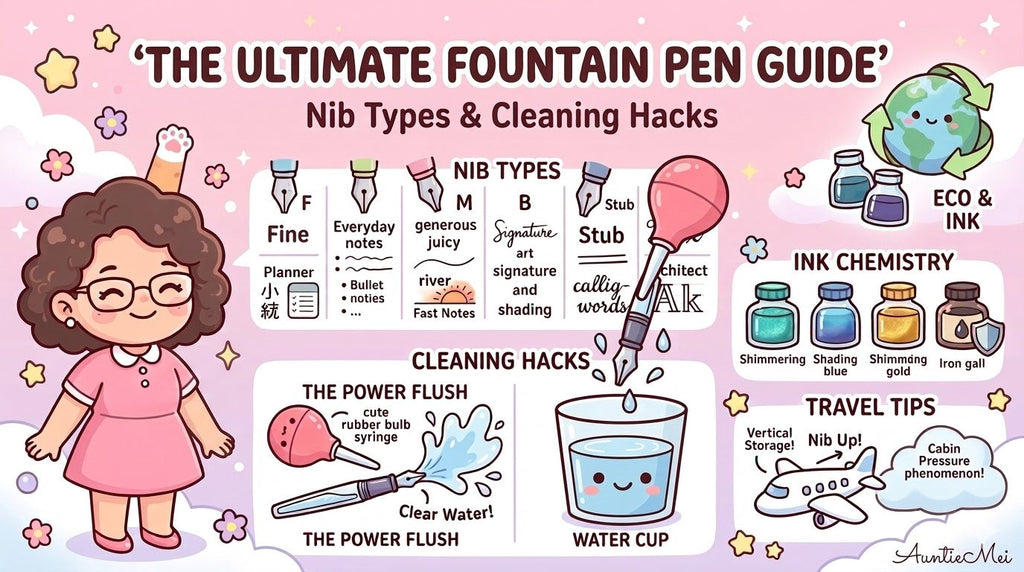
The nib size dictates the thickness of your line and how much ink is delivered to the paper. Choosing the right size is crucial because fountain pen ink is very wet. If you choose a Broad nib but write on cheap, thin notebook paper, the heavy volume of ink will immediately feather (spread like a spiderweb) and bleed through to the other side.

EF (Extra Fine) & F (Fine): The Planners' Best Friends
If you use a small pocket notebook, if you write tiny "ant words," or if you write complex Asian characters (Kanji/Hanzi) with dense strokes, these are your go-to nibs. They lay down very little ink, which means they dry almost instantly. Because the ink volume is so low, EF and F nibs are incredibly forgiving and will write beautifully even on cheap, low-quality office copy paper without bleeding through.
M (Medium) & B (Broad): The Shading Kings
Medium and Broad nibs lay down a generous, juicy river of ink. Because there is a larger surface area of iridium tipping touching the paper, they feel incredibly smooth. They are perfect for fast note-taking, writing large signatures, and showing off the beautiful shading and sheen of specialty inks.
Why do some dark blue inks dry with a brilliant, metallic red glow? It’s all about the paper's coating (known as Sizing). Standard cheap paper absorbs ink instantly, pulling the dye deep into the fibers and dulling the color. Premium fountain pen papers, like Tomoe River or Midori MD, feature a microscopic surface coating that actively delays absorption. The water content evaporates first, leaving the heavy dye molecules to pool and crystallize directly on the paper's surface, creating that magical metallic luster known as "Sheen."
The Specialty Grinds: Stub, Flex, and Architect Nibs
- Stub Nib (1.1mm+): The tip is ground flat like a chisel rather than a round ball. When you pull the pen down, it makes a thick line; when you move it sideways, it makes a razor-thin line. It instantly makes your everyday handwriting look like professional calligraphy with zero extra effort.
- Flex Nib: Designed with highly elastic tines that spread wide when you press down, creating dramatic line variations common in Spencerian or Copperplate script.
- Architect Nib: The exact opposite of a Stub. It writes thin on the downstroke and thick on the cross-stroke. It was originally designed for architects drawing straight, bold horizontal lines for blueprints, but it makes print handwriting look incredibly stylized.
Not all nibs are created equal. Because the Japanese language involves writing complex characters in small grid spaces, Japanese brands (like Pilot, Sailor, and Platinum) grind their nibs much finer than European brands (like Lamy, Pelikan, and Kaweco).
The Rule of Thumb: A Japanese "Fine" (F) is usually equivalent to a Western "Extra Fine" (EF). If you love the line width of a German Lamy Fine, you should order a Japanese Pilot Medium!
Part 3: The Great Debate - Gold vs. Steel Nibs

There is a massive, expensive misconception in the stationery community that you must spend $200 on a 14K or 21K solid gold nib to get a "smooth" writing experience. This is absolutely false.
Historically, gold nibs were necessary because vintage inks were highly acidic (like iron-gall ink) and would literally rust and corrode early steel nibs. Modern stainless steel alloys do not rust. Furthermore, remember the anatomy section? The part of the pen that actually touches the paper is the hard iridium tipping, not the gold or steel body. A well-polished steel nib from a reputable brand will write vastly smoother than a poorly polished 21K gold nib.
The Sensory Mechanics: Feedback vs. Smoothness
A common mistake for beginners is assuming that all good pens must be "as smooth as butter." In reality, many top-tier Japanese brands (most notably Sailor) intentionally engineer a microscopic texture into their tipping material. This provides a distinct "pencil-like feedback"—a gentle, satisfying, and audible whisper against the paper that offers extreme control for precise lettering. Smoothness allows for speed, but feedback provides control.
Furthermore, because you hold a fountain pen at a consistent angle, the microscopic iridium tip will slowly polish itself against the paper over months of use. It develops a "Sweet Spot" perfectly tailored to your unique grip and writing angle. This is exactly why borrowing someone else's well-used fountain pen often feels awkward and scratchy!
Part 4: Ink Chemistry & Why You MUST Clean Your Pen

Unlike a ballpoint pen, a fountain pen is a controlled leak. The ink inside is mostly water mixed with water-soluble dyes. If you leave a fountain pen sitting on your desk unused for weeks, the water will slowly evaporate, leaving behind a crusty, highly concentrated layer of solid dye pigment inside the microscopic channels of the feed.
This is especially dangerous if you use Shimmer Inks (inks containing actual mica glitter powder) or Pigment Inks (waterproof carbon inks). If these dry inside your pen, they will turn into microscopic cement, permanently blocking the capillary action and ruining the pen.
Iron Gall Inks: Beloved for their absolute permanence, these historical inks bind tightly to paper fibers through a chemical oxidation process. While excellent for archival documents, their inherent acidity demands extreme vigilance; they must be flushed regularly to prevent them from corroding steel nibs.
⛔ The Ink Death Sentence: India Ink
Many beginners buy "Calligraphy Ink" or "India Ink" at craft stores because it is pitch-black, highly opaque, and cheap. NEVER put drawing/India ink in a fountain pen. These inks contain Shellac (a permanent resin binder) which dries into an irreversible, waterproof plastic shell. It will permanently destroy the feed mechanism of your pen in a matter of minutes.
⚠️ Another Fatal Warning: Never Use Alcohol!
If your pen is severely clogged, you might be tempted to soak it in rubbing alcohol, hand sanitizer, or acetone. Do not ever do this. Alcohol acts as a harsh solvent that will instantly melt, cloud, or permanently shatter certain fountain pen plastics, precious resins, and vintage celluloid barrels. Only use water or a dedicated fountain pen flush.
Part 5: How to Clean a Fountain Pen (The 5-Minute Hack)
You should clean your pen every 2 to 4 weeks, or every time you want to switch to a different ink color. Running the pen under a slow dripping tap takes forever and wastes water. Instead, use Auntie Mei's Bulb Syringe method.

1. The Power Flush (Everyday Cleaning)
- Disassemble: Unscrew the barrel and remove the ink cartridge or converter. You are left with the "Grip Section" (the piece holding the nib and feed).
- The Magic Tool: Buy a cheap rubber "Bulb Syringe" (the kind used for clearing baby noses) from any pharmacy. Fill it with room-temperature tap water.
- The Blast: Stick the tip of the bulb syringe onto the back of the grip section where the ink cartridge usually goes. Squeeze firmly! This forces a high-pressure blast of water straight through the feed and out the nib, flushing out all the old ink in 5 seconds. Repeat until the water runs completely clear.
- Dry: Gently tap the nib against a paper towel to draw out the remaining moisture via capillary action, and let it air dry overnight.
2. The Deep Clean (For Clogged Pens)
If your pen has been sitting in a drawer for a year and is totally crusted shut, the bulb syringe might not push through. You need to break down the dried dye.
- DIY Pen Flush Recipe: Mix 1 part clear household ammonia with 10 parts distilled water, and add exactly one drop of mild liquid dish soap. The ammonia breaks down the dye, and the dish soap acts as a surfactant to help the water penetrate the microscopic fins.
- The Soak: Let the nib section soak in this solution overnight. Flush thoroughly with clean water the next morning.
- Ultrasonic Cleaners: For hardcore collectors, dropping the nib section into a jewelry ultrasonic cleaner filled with water will vibrate the dried ink out of the feed in 3 minutes flat.
Part 6: Troubleshooting (Why won't my pen write?)

If your pen has plenty of wet ink but still won't write, or feels incredibly scratchy, check for these two common ailments:
- Misaligned Tines: Look at the tip of the nib under a magnifying glass. If one tine is bent slightly higher or lower than the other, the sharp inner edge will dig into the paper fibers like a razor blade. This causes severe scratchiness and disrupts ink flow. You can gently press the higher tine down with your fingernail to realign them.
- Baby's Bottom: This is a manufacturing defect where the inner edges of the iridium tipping are over-polished and too rounded (looking like a baby's bottom under a loupe). Because the slit doesn't actually touch the paper, capillary action fails, resulting in the pen constantly skipping on the first stroke of a letter. This requires professional tuning or micro-mesh sanding to fix.
Part 7: The 2026 Lifestyle & Travel Hacks (Avoiding Disasters)

📱 Hybrid Workflow: OCR & Tactile Memory
In 2026, pure analog writing often needs to sync with digital ecosystems. If you use tablet scanners (like Adobe Scan or Notion) to digitize your notebooks, the depth and behavior of your ink matters. Opt for highly saturated Carbon Black or vibrant Pigment Blue inks, as they provide the highest contrast for flawless Optical Character Recognition (OCR) accuracy. Beyond digitization, psychological studies on encoding confirm that the physical resistance (feedback) and micro-vibrations of a fountain pen nib traveling across paper create strong neural pathways, significantly enhancing long-term memory retention compared to tapping on a glass tablet screen.
✈️ The Cabin Pressure Phenomenon (Air Travel)
Frequent business travelers take note: a fountain pen on an airplane can become a pressurized ink bomb. As the aircraft climbs, the cabin air pressure drops. The air trapped inside your pen's converter will expand, violently pushing the ink out through the nib (a messy phenomenon called "Burping"). The Fix: Before takeoff, either fill your pen 100% full (eliminating the expanding air) or empty it completely. Always store the pen vertically with the nib pointing UP during the flight to ensure only air escapes, not ink.
🧪 The Plasticizer Meltdown (Storage Danger)
A crucial warning for your pencil case: Never store expensive resin, acrylic, or vintage celluloid fountain pens in direct, long-term contact with cheap plastic rulers or rubber erasers. The chemical plasticizers used to make erasers soft can migrate into the pen's body, causing a catastrophic chemical reaction that literally "melts" or permanently scars the expensive resin.
Part 8: The Cheat Sheet Matrices (Compare & Decide)
Table 1: The Nib Size & Handwriting Matrix
| Nib Size | Approx. Line Width | Best For (Use Case) | Paper Requirement |
|---|---|---|---|
| EF (Extra Fine) | ~0.3mm | Micro-journaling, complex math, Asian characters | Works beautifully on cheap copy paper (minimal bleeding) |
| F (Fine) | ~0.4mm | Everyday notes, standard bullet journaling | Standard notebooks (90gsm+) |
| M (Medium) | ~0.6mm | Fast writing, showing off ink shading and sheen | Requires high-quality paper (e.g., Tomoe River, MD) |
| Stub (1.1mm+) | Variable (Thick/Thin) | Calligraphy, headers, dramatic signatures | Premium fountain-pen-friendly paper essential |
Table 2: The Maintenance Schedule
| Timeframe | Maintenance Action | Why it is Necessary |
|---|---|---|
| Every 2 - 4 Weeks | Basic bulb syringe water flush | Prevents microscopic paper dust and dried dye buildup in the nib slits. |
| Changing Ink Colors | Deep flush with water or pen flush | Prevents unwanted chemical reactions and muddy, mixed ink colors. |
| Long-Term Storage | Flush completely, air dry, and store empty | Prevents ink from permanently cementing inside the delicate feed mechanism. |
Table 3: The Ink Chemistry & Cleaning Matrix
| Ink Type | Characteristics & Visuals | Risk Level | Recommended Cleaning Frequency |
|---|---|---|---|
| Standard Dye Inks | Vibrant colors, easy to clean, low maintenance | ⭐ Low | Every 4 - 6 Weeks |
| Sheening Inks | Heavy dye saturation, brilliant metallic red/gold shine | ⭐⭐⭐ Medium | Every 2 Weeks (Prone to crusting on the nib) |
| Shimmer Inks | Contains suspended mica/glitter for massive visual impact | ⭐⭐⭐⭐ High | Weekly, or immediately after emptying |
| Waterproof / Iron Gall | Archival permanence, binds to paper, highly acidic | ⭐⭐⭐⭐⭐ Extreme | Every 5 - 7 Days (Do NOT let dry in pen) |
Frequently Asked Questions (FAQ)
Absolutely not. Alcohol acts as a harsh solvent that will instantly melt, cloud, or permanently crack many common fountain pen plastics, precious resins, and vintage celluloid materials. Always use room-temperature water or a dedicated, pH-balanced fountain pen flush.
As a general rule, you should flush your pen with water every 2 to 4 weeks if you write with it regularly. You must also clean it thoroughly every time you want to switch to a new ink color, or if you plan to store the pen away without using it for more than a couple of weeks.
A scratchy pen is almost never due to a lack of ink. It is usually caused by "misaligned tines"—meaning one half of the nib tip is bent slightly higher or lower than the other, causing the sharp inner edge to catch the paper fibers. It can also be caused by pressing down too hard; fountain pens require zero downward writing pressure.
Yes. Because the Japanese language involves writing complex, dense characters in small spaces, Japanese brands (like Pilot, Platinum, and Sailor) grind their nibs roughly one whole size finer than their European counterparts (like Lamy or Pelikan). A Japanese Fine (F) writes exactly like a European Extra Fine (EF).
This depends heavily on the pen's cap seal mechanism. Some premium pens (like the Platinum #3776 with its spring-loaded Slip & Seal mechanism) can keep ink wet for over a year. However, for most standard pens, if you aren't going to use it for over two weeks, it is much safer to clean it out so the water doesn't evaporate and clog the feed.
A Stub nib has a flat, broad tip rather than a round iridium ball. When you pull the pen down vertically, it makes a thick line; when you move it sideways horizontally, it makes a thin line. It is used to easily create beautiful, calligraphy-style lettering without needing to learn complex flex-nib pressure techniques.
Not necessarily. The absolute smoothness of a pen depends entirely on how well the hard tipping material (iridium/osmium) is polished, not the gold or steel body. An expertly tuned steel nib will write vastly smoother than a cheap, poorly finished gold nib. Gold simply provides a softer, bouncier feel (elasticity) on the paper.
Ready to Upgrade Your Writing?
Now that you know the secrets of nib sizes, ink chemistry, and maintenance, it's time to experience the joy of a good fountain pen. Pair it with our premium, bleed-proof notebooks for the ultimate journaling experience.
Shop Premium Pens & Paper