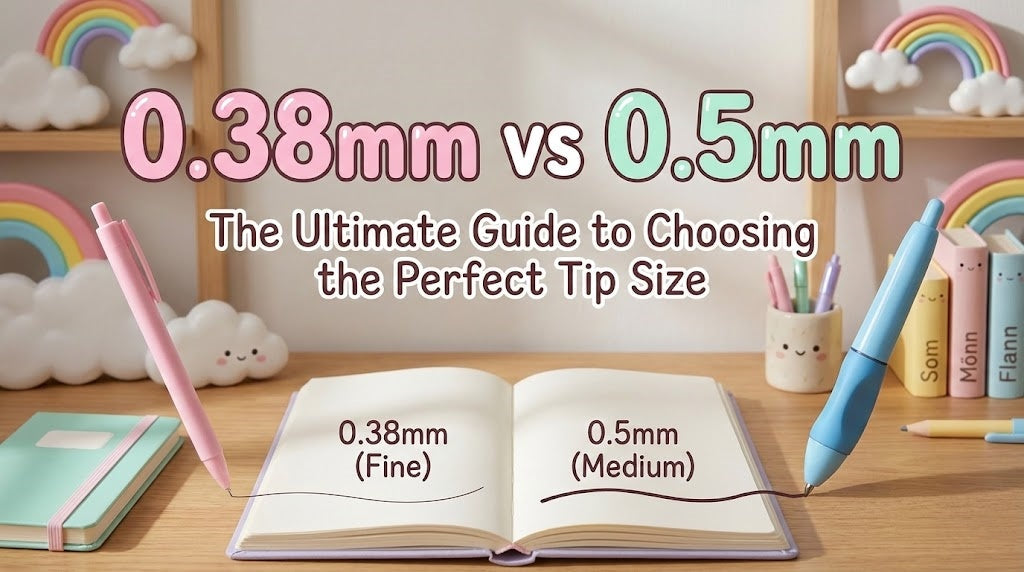
0.38mm vs 0.5mm: The Ultimate Guide to Choosing the Perfect Tip Size
Written by Auntie Mei
MyKawaiiStationery Owner. I am a self-confessed "Micro-Writer." I spent 5 years analyzing ink flow, tip geometry, and paper textures to understand why some pens scratch and others glide.
If you walk into a standard office supply store in the US or UK and ask for a "Fine" pen, they will hand you a 0.7mm ballpoint. To a Japanese stationery enthusiast, that is not a pen; that is a marker.
Welcome to the world of precision writing. In the universe of Japanese stationery (ruled by giants like Pilot, Uni-ball, and Zebra), the battle lines are drawn much finer. The war isn't between Bold and Fine. It is between Standard Fine (0.5mm) and Ultra Fine (0.38mm).
To the untrained eye, 0.12mm seems like a meaningless difference. It’s less than the thickness of a human hair. But ask any bullet journaler, manga artist, or Hobonichi user, and they will tell you: It changes everything.
It changes how you hold the pen. It changes which paper you can use. It changes how your handwriting looks. In this comprehensive guide, we are going to explore the physics, the ink science, and the practical applications of these two tip sizes so you never buy the wrong refill again.

⚡️ The 30-Second Cheat Sheet
| Feature | 0.38mm (Ultra Fine) | 0.5mm (Standard Fine) |
|---|---|---|
| Best Application | Hobonichi (Grid), Bible, Kanji | School Notes, Journaling |
| Smoothness | Scratchy (High Feedback) | Buttery Smooth WINNER |
| Ink Flow | Restricted (Dries Fast) WINNER | Generous (Saturated) |
| Forgiveness | Zero (Catches on paper) | High (Easy to use) WINNER |
1. The "Scratch" Factor: Physics of Feedback
This is the number one complaint I receive from customers who blindly switch to 0.38mm: "Auntie Mei, this pen is broken. It feels scratchy."
It is not broken. It is physics.
The Surface Area Problem
Imagine wearing stiletto heels vs. sneakers on soft grass. The stiletto sinks in because all the weight is focused on a tiny point. A 0.38mm tip is a stiletto. It exerts immense pressure per square millimeter on the paper fibers.
This sensation is called Feedback. Artists and Architects often love feedback because it feels precise, like an etching tool. Fast writers often hate it because it creates resistance (drag) that slows them down.
The "Angle of Attack"
If you choose 0.38mm, you must adjust your posture. A 0.5mm pen is forgiving; you can hold it at a low angle (45 degrees). A 0.38mm pen requires a steeper angle (closer to 60-70 degrees). If you hold a 0.38mm pen too low, the metal rim of the casing will scrape against the paper, causing that horrible "nails on a chalkboard" feeling.
2. Tip Geometry: Needle vs. Conical
When you drop down to micro-sizes, the shape of the metal tip becomes crucial.

Needle Tips (Pipe Tip): Most 0.3mm and 0.38mm pens (like the Pilot Hi-Tec-C) use a needle tip.
Pros: Incredible visibility. You can see exactly where the ink is landing, which is vital for using rulers.
Cons: Fragility. If you drop a needle-tip pen nose-first onto hard tile, it is dead. The pipe bends instantly.
3. Paper Pairing: The "Hobonichi" Factor
You cannot choose a pen in a vacuum. You must choose a pen for your paper.
If you use Tomoe River Paper (Hobonichi Techo) or high-quality smooth paper, 0.38mm is the king. These papers are coated, so the sharp tip won't tear them. The thin line allows you to write legible characters inside tiny 3.7mm grids.
If you are writing on standard office copy paper, DO NOT use 0.38mm. The sharp tip acts like a knife, slicing through loose paper fibers. These fibers get stuck inside the tip, clogging the ink flow. Use 0.5mm instead.
4. Handwriting Analysis: The "Blob" Effect
Look at your current handwriting. Specifically, look at the "loops" in your letters—the top of an 'e', the circle of an 'a', or the loop of a 'g'.

The 0.5mm Problem: If you have naturally small handwriting, a 0.5mm line is often too thick. The ink spreads slightly, causing the loops to fill in. Your 'e' looks like a black dot.
The 0.38mm Solution: This size provides "White Space Preservation." It keeps the inside of your loops open and crisp. It instantly makes messy handwriting look neater.
5. Ink Science: Viscosity and Color
It's not just about the metal tip; it's about the liquid inside.
Saturation vs. Shade
0.5mm puts down more ink. This means colors look darker, richer, and more vibrant. If you are using a "Vintage Color" or "Neon" ink, 0.5mm will show off the special hue better.
0.38mm puts down a very thin layer. Lighter colors (like yellow, pale pink, or light green) can become almost unreadable at 0.38mm. If you stick to 0.38mm, I recommend using high-contrast colors like Blue-Black, Black, or Red.
The Left-Handed Smudge Test
For lefties, 0.38mm is a secret weapon. Because it releases 40% less ink volume than a 0.5mm tip, it dries almost instantly. Even standard gel inks (which are usually slow to dry) become "Quick Dry" when dispensed through a 0.38mm tip. No more Silver Surfer hand.
6. Brand Showdown: Not All Millimeters Are Equal
Warning: "0.38mm" is not a standardized measurement across brands. It is a marketing term. Here is how the big brands differ:
- Uni-ball Signo DX (0.38mm): The gold standard. It feels slightly thicker and smoother than others. Highly reliable.
- Pilot Juice Up (0.4mm): Pilot calls it 0.4mm, but it writes like a 0.35mm. It uses a unique "Synergy Tip" that is very smooth.
- Pilot Hi-Tec-C (0.4mm): The sharpest, scratchiest, most precise pen on the market. Only for advanced users.
- Muji Gel Pens: Muji's 0.38mm is notorious for being scratchier than Uni, but excellent for grid paper.
7. Maintenance: How to Unclog a Micro-Tip
Small tips clog easily. Before you throw away a "dead" 0.38mm pen, try these Auntie Mei hacks.
1. The Shoe Sole Trick: Paper fibers often get stuck in the ball. Take your shoe (rubber sole) and scribble hard with the pen. The rubber grip pulls the microscopic fibers out.
2. The Hot Water Bath: Sometimes dried ink crusts over the tiny opening. Put the tip (just the tip!) in hot water for 30 seconds to dissolve the clog.
FAQ: 8 Common Questions
Actually, the opposite! Because it puts down less ink per inch, a 0.38mm refill usually lasts longer than a 0.5mm refill. However, it feels like it runs out faster because you are doing more writing to fill the page.
Be careful. Scantron sheets (bubble sheets) require you to fill in circles completely. Using a 0.38mm pen to fill bubbles takes forever. Use a 0.7mm or a pencil for bubbles, and 0.38mm for essays.
This is called "breaking in." Sometimes microscopic burrs on the metal ball need to be worn down. Scribble on a glass surface to smooth it out.
Yes, it is fantastic for "Line Art" and cross-hatching. It allows for extreme detail. Do not use it for coloring in, or you will damage the paper.
YES! Most Japanese brands (Uni One, Sarasa, EnerGel) use universal barrel sizes. You can buy a cute 0.5mm body and put a 0.38mm refill inside.
The Pilot Hi-Tec-C 0.25mm is widely available. It feels like writing with a needle and is extremely fragile, but amazing for miniature art.
Because of Kanji characters. Writing complex characters with 10-20 strokes in a small space requires a thin line. A 0.7mm pen creates a black blob.
Use 0.5mm or 0.7mm. Carbon copies rely on pressure. You shouldn't press hard with a 0.38mm pen (risk of bending), so it often fails to transfer.
Ready to Choose Your Weapon?
Do you want surgical precision or smooth comfort?